Steve Dunham’s Trains of Thought

Return to the home page

VRE gallery cars in Washington

“Commuter Crossroads”—commuting by transit and trolley

Commuter Crossroads main page
Commuting by bus
Commuting by train
Commuting by bicycle and walking
Commuting by car
More Commuter Crossroads topics

Dulles Rail Project Moves Ahead (Aug. 8, 2004).
Metro Communications Fall Short (Jan. 11, 2004).
Trolleys Combine Heritage, Tourism, and Transportation (May 18, 2003).
Metro Increases Capacity and Security (Jan. 12, 2003).
Metro Changed the Face of Washington (Oct. 13, 2002).
VRE’s Metro Connection (Jan. 9, 2000).

[More “Commuter Crossroads”]

[Return to the home page]


Dulles Rail Project Moves Ahead

By Steve Dunham

This column appeared in the Fredericksburg, VA, Free Lance–Star on Aug. 8, 2004, and is reproduced with permission.
The Metro rail line to Dulles International Airport is changing from a dream into a plan. Last month the Federal Transit Administration granted almost $59 million for preliminary engineering of the line between Reston and Falls Church (where it would join the existing Metro Orange Line). If money for construction follows, trains could begin rolling to Reston in 2010. Phase II would take the line all the way to Dulles, perhaps 5 years later.

What does this mean for the Fredericksburg area? Have you ever driven to Dulles? From our house in Massaponax, it’s about 70 miles to Dulles. Under good conditions it’s a two-hour drive. The trouble is, conditions are often bad and, worse, unpredictable. Taking Virginia Railway Express and Metro to Dulles would be a longer distance but maybe not take any longer and almost certainly be more predictable. And that’s considering only the one-way trip. If you’re taking someone to the airport or picking someone up, that’s an often grueling drive of more than a hundred miles round trip.

When a relative flies to Virginia for a visit, I say, “Please fly to Reagan National Airport or Baltimore-Washington International.” Then I leave the car at home and take the train to the airport. I bring an extra VRE ticket when I meet my visitor, and we take the train to Fredericksburg (the VRE ticket is also good on most Maryland Rail Commuter trains between Washington and BWI). Air travel has gotten to be enough hassle without having to drive to the airport too. I think a lot of travelers in the Fredericksburg area will feel the same way.

The Dulles Metro line will intersect VRE’s Fredericksburg line at L’Enfant Plaza in Washington, D.C. Transfers from one line to the other—especially with luggage—are an inconvenience to travelers, but I would find just one transfer bearable and certainly preferable to driving.

However, rail service to Dulles is more than 10 years in the future. The Phase I service to Reston has something to offer Fredericksburg too: It will open up new commuting possibilities. When I look at the employment ads and see that a job is in Tyson’s Corner or Reston, I stop reading. I could get to those places by transferring from VRE to a Metro bus at Alexandria or Crystal City, but the trip to work would take even longer than my present commute to Shirlington. Once Metro rail reaches Reston, there would be faster, more frequent service, and I would at least consider traveling farther to take a good job.

A lot of people are looking forward to riding the Dulles line. Despite federal reluctance, now being overcome, Virginia has embraced the long-overdue rail service. While transportation projects elsewhere have been hampered by people saying, “Not in my back yard,” the Dulles line has been welcomed locally, with the Dulles Corridor Rail Association (a citizens’ group) being a champion for the line, insisting on rail rather than bus service. In March, the association’s president, Patty Nicoson, addressed the annual meeting of the Virginia Association of Railway Patrons (another citizens’ group), discussing progress on the project. She explained that the town of Herndon balked at paying its share toward Phase I of the Dulles service only because it was concerned because Phase II isn’t guaranteed to be built. Herndon, like other communities along the line as far out as Loudoun County, wants rail rapid transit.

So far, popular demand has overcome the doubts of politicians and transportation planners and has gotten the Dulles rail corridor project under way. I’m willing to be that popular demand will get the rail line built all the way to the airport.

[More “Commuter Crossroads”]

[Return to the home page]


Metro Communications Fall Short

By Steve Dunham

This column appeared in the Fredericksburg, VA, Free Lance–Star on Jan. 11, 2004, and is reproduced with permission.

Riding Metrobuses is complicated enough. When schedules change without warning, it gets downright frustrating.

Riding Metro’s rail lines is fairly easy. You can see most of the stations from blocks away, the trains run pretty much all the time between dawn and midnight and you can just show up and expect a train within minutes. A color-coded map shows all hundred or so stations.

The Metro bus system is much more complicated—finding the bus stops, for example. A lot of them are grouped at Metrorail stations and are fairly easy to locate. Away from the rail stations, though, it gets harder. When my employer moved to Shirlington a few years ago, I used Metro’s bus map (which looks like a bowl of multicolored spaghetti) to locate several bus routes that served the neighborhood. Armed with the information that the two bus stops (one for each direction, on opposite sides of the street) were at South Quincy Street and 28th Street, I still had to search up and down the streets on either side of the intersection to find the bus stops.

Even if you know which bus line you want, you can’t necessarily just go to a bus stop and wait. Some bus routes don’t operate every day; some run every half hour or during rush hours only. In practice, this means you have to do some research before you ride.

Once you have sought out the information and are ready to ride the bus, you face one more obstacle: the information might be wrong.

This happened on the day after Christmas, when Metro, after saying it would run normal weekday service, suddenly decided to operate a different schedule. That morning, I and another passenger showed up at a bus stop in time for a scheduled bus to Shirlington. Shortly after the bus was due, one pulled up, and the driver parked and turned off the lights. He wouldn’t be leaving for almost half an hour. The bus we were waiting for had been canceled.

Not just that bus had been canceled, either. That morning, our driver informed us, Metro had decided to reduce rush-hour service and had sent some drivers home, frustrating both employees and passengers.

A reduction in service was in order. A last-minute decision was not. The federal government had announced weeks earlier that its offices would be closed on Dec. 26. It was bound to be a light travel day for commuting. Virginia Railway Express and Alexandria Transit had announced that they would operate reduced service on that day.

Instead of deciding ahead of time that a reduced schedule was appropriate, Metro waited until some drivers had returned from visiting families far away and until passengers were waiting at bus stops before cutting service. Our driver said that the bus service has been run that way for years.

In some ways, including communications on the rail lines, Metro is one of the best transit systems in America. One of its innovations is the electric signs on the train platforms informing riders when the next train will arrive and where it is bound.

Out on the streets, bus riders—a huge and important part of Metro’s ridership—generally have to find their own information, and then it might be wrong.

It’s high time that Metro upgraded its bus service and communications and simplified its routes with more trunk lines, like the new Columbia Pike service. For example, I often ride the number 10 bus. There are 10A, 10B and 10E buses with partly overlapping routes and different destinations, and none of them goes straight from anywhere to anywhere. The 10B turns at least a dozen times in the three or four miles between downtown Alexandria and Shirlington. The trip is generally northwestward, but sometimes the bus is traveling south or east, like a strand of spaghetti.

The service pattern is partly ordered by the cities and counties served by Metro, but the jurisdictions should approve of a plan to make a lot of the bus routes more direct, with buses running more often and all day. Then Metro should publish schedules and stick to them.

[More “Commuter Crossroads”]

[Return to the home page]


Trolleys Combine Heritage, Tourism, and Transportation

By Steve Dunham

This column appeared in the Fredericksburg, VA, Free Lance–Star on May 18, 2003, and is reproduced with permission.


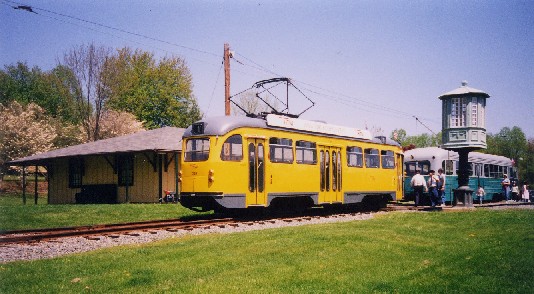
The bouncing banana from The Hague and a A 1935 Washington, D.C., streamlined car.
Photo copyright Steve Dunham 2003.
Imagine riding a real trolley through Fredericksburg. It might begin its trip at the battlefield visitor center, stop at the railroad station, travel through town (maybe on Sophia Street, which has less traffic), and even go as far as Central Park, Celebrate Virginia or the National Slavery Museum. This would be a vintage or reproduction electric streetcar operating on rails—not a bus with trolley trappings, nor a full-fledged light railway like Baltimore’s. It would be North America’s 21st heritage trolley line.

Large cities such as Memphis, Tampa, and Detroit operate heritage trolleys, which dramatize the cities’ history, draw tourists, and provide everyday transportation. But heritage trolleys aren’t just for big cities. Small cities, too—including Lowell, Mass.; Kenosha, Wisc.; and Fort Collins, Colo.—have heritage trolley lines. Most of these 20 cities have revived former trolley lines or built new ones; the St. Charles line in New Orleans became a heritage trolley operation simply because it lasted so long.

Fredericksburg’s heritage trolley line could operate in the street or on its own right of way or—like many heritage trolleys and light railways—do some of both. If it ran every 15 minutes, it wouldn’t be adding to traffic. In fact, it might help mitigate traffic if some of its 40 seats were filled by people who otherwise would have driven into town. People also would be more likely to use a remote parking area for special events such as First Night if the trip into town were via a real trolley.

To get an idea of what a Fredericksburg heritage trolley line would be like, you can visit the National Capital Trolley Museum in Colesville, Md., outside Washington, D.C. On Saturday and Sunday afternoons (plus some Thursday and Friday operations in warm weather), the museum operates vintage trolleys from North American and European cities on a short trip through a park. Some cars in the collection are more than a hundred years old, while others, like the Dutch car built in 1971 (the museum’s newest), are remarkably modern. The Washington, D.C., streamlined car built in 1935 offers a smooth ride, whereas the car from Johnstown, Pa.—only 9 years older—looks and feels more like an antique. Clearly they are from two different generations of trolleys.

Sampling the trolleys gives you a taste of various decades of urban transportation, and maybe an idea of which kind of car would work best in Fredericksburg.

Admission to the grounds is free, and the grounds have a picnic grove, trolleys on display, and a museum describing the history of trolleys in general and Washington, D.C., lines in particular. A trolley ride costs $2 for kids up to 17 and senior citizens, $3 for everyone else. If you ride just one trolley, though, you might get the idea that they are all alike. For a few dollars extra, you can get a five-ride ticket, and you don’t have to use all five rides in one day.

To get to the museum, driving to Maryland is one choice, and I did that once. On a Sunday afternoon in April, I made a better choice: I and two of my kids went by train. You can take Amtrak to Union Station in Washington, and the Metro from there to the end of the Red Line at Glenmont. The Montgomery County Ride On bus number 26 goes to the museum every half hour; it’s about a 10-minute ride, and the bus takes you right onto the museum grounds.

The National Capital Trolley Museum is at 1313 Bonifant Road, Colesville, Md., between Layhill Road and New Hampshire Avenue. The phone number is (301) 384-6088. Special events and children’s programs are listed on the website at www.dctrolley.org.

To learn more about the 20 existing heritage trolley operations in the United States and Canada, visit the heritage trolley website at www.heritagetrolley.org.

[More “Commuter Crossroads”]

[Return to the home page]


Metro Increases Capacity and Security

By Steve Dunham

This column appeared in the Fredericksburg, VA, Free Lance–Star on January 12, 2003, and is reprinted with permission.

The Washington Metro has some impressive improvements lined up for this year. Although Metro just might be the best transit system in America, it is still moving ahead—straining to keep up with the crowds of riders but also leading the industry with security innovations and acting to reduce pollution.

For some Fredericksburg-area commuters, Metro is the final link in the journey to their offices. For other travelers, it is the service takes them to the front door of Reagan National Airport. For families, it is the train that takes them to the National Zoo or the Air and Space Museum on weekends. Virginia Railway Express riders have five possible transfer points to Metro; Amtrak riders have two. Sometimes, however, using Metro means driving to a Metro station, particularly if you want to spend the evening in Washington.

For anyone who has driven to the Franconia-Springfield Metro station, about 40 miles north of Fredericksburg, the Washington Metropolitan Area Transit Authority has some good news: the parking facility, which fills up early on weekdays, is getting 1,000 more parking spaces, and the work should be finished this summer. Other stations throughout the system are getting increased parking capacity as well.

Also by this summer, Metro should have all 192 of its new cars in service. About half are in operation now. Added to the eight hundred–plus cars in the current fleet, these new vehicles will enable Metro to operate six cars on all rush-hour trains, some of which now have only four. Although rush-hour crowding has been most noticeable on the Green Line to Branch Avenue in Suitland, which opened in January 2001, six-car trains will be welcome to rush-hour riders on any line. The new cars will also allow Metro to remove some older cars from service for overhaul work. Metro has ordered an additional 62 cars, and is working to secure funding for 120 more after that so that the system can operate eight-car trains.

Besides expanding its fleet, Metro continues to expand its rail system. Work is under way on the Red Line station at New York Avenue and on the Blue Line extension to Largo, both of which are expected to open next year. Planning has begun for the Dulles Airport line and for the Purple Line, which would parallel the Capital Beltway in Maryland—and wouldn’t a complete Purple Line all the way around Washington be a welcome alternative to the Beltway?

Less visible are Metro’s security enhancements—in fact, some of the details are secret. In plain sight will be the additional officers on the transit police force. Less noticeable will be the security cameras being installed on 100 buses. And in a program that long predates September 11, 2001, Metro will continue adding chemical detectors to unspecified stations. Metro has also added more canine bomb-detection teams in recent months. Although America has not suffered the kind of terrorism on transit systems that has taken place in Britain, Japan, and other countries, it is reassuring to know that Metro is making itself a difficult target.

As the Washington region continues to struggle with air quality, the transit authority has made major efforts to reduce pollution. Metro begins the new year with a fleet of 164 buses powered by compressed natural gas, all of them delivered in the past 12 months. This year, Metro will begin installing after-treatment filters on 600 of its diesel buses to nearly eliminate emissions of particulate matter and will repower 100 diesel buses with new engines that meet the latest Environmental Protection Agency regulations. (Metro’s trains are electric and produce no emissions.)

For some of us, “subway” has always meant Metro. For some of us who moved to Virginia from other states, Metro is astonishingly better than some other subways we’ve ridden. With the kind of improvements the transit authority keeps making, you can see why the system keeps setting ridership records despite a sour economy.

[More “Commuter Crossroads”]

[Return to the home page]


Metro Changed the Face of Washington

By Steve Dunham

This column originally appeared in the Fredericksburg, VA, Free Lance–Star on October 13, 2002, and is reproduced by permission.

The next time you’re in Washington, D.C., whether you’re going to work, visiting the Smithsonian, or taking a trip to the zoo, imagine the city without the Metro system. Imagine, instead, 28 more miles of highway, passing through Georgetown, bordering the Potomac River, coming close to the Jefferson Memorial, and adjoining the National Arboretum. In the 1960s, Washington had a choice between more highways or a rapid-transit system. The result is part of the modern face of the city and its suburbs; the alternative is almost unimaginable.

Nothing has changed the face of Washington the way Metro has, or repaid the dividends invested in it, according to Rudolph A. Pyatt, Jr., a retired Washington Post business columnist and a former Metro skeptic. Pyatt addressed the opening session of a conference called “Rail-volution: Building Livable Communities With Transit,” last weekend in Washington. After decades of writing about the Washington business environment and noting the influence of transportation policy, Pyatt now opposes further highway construction in the city, saying that more roads lead inevitably to more gridlock.

This former Metro skeptic also refutes one of the skeptics’ arguments that is still heard today: that transit-oriented development with its higher density will attract so much road traffic as to overwhelm any gains made by transit. The fact is, he said, that development focused on transit access has enabled neighborhoods to maintain a scale suited for people. For proof, he said, walk around Alexandria, Ballston, or Bethesda.

Without rapid transit, those neighborhoods, and many others in the Washington metropolitan area, would have a very different face. Washington had a trolley system—real electric trolleys on rails, not rubber-tired, gasoline-burning imitations—but the last line was abandoned in 1962, as Washington was becoming a city that depended principally on cars to take people everywhere.

Only the vigorous protests of Washington residents stopped the 28 additional miles of highway from being built. Instead of highways, after fierce political fighting and close calls, Washington got Metro, now 103 miles long and still growing. The latest addition, and the most significant for Virginia, is on the verge of approval to go forward: an extension from Falls Church to Dulles International Airport.

Such transportation policies and choices have shaped the world we live in and work in. They have changed the face of the cities to which many of us commute, and they are changing the face of Fredericksburg and its surrounding area.

[More “Commuter Crossroads”]

[Return to the home page]


Commuter Crossroads

VRE’s Metro Connection

By Steve Dunham

This column appeared in the Fredericksburg, VA, Free Lance–Star January 9, 2000, and is reproduced here by permission.

The Washington Metro is the connection of choice for people traveling to many places beyond the range of Virginia Railway Express. VRE directly serves Alexandria (near the bulk of the downtown offices), Crystal City (walking distance to everything in that corner of Arlington), L’Enfant Plaza (Federal offices and the Smithsonian museums) and Union Station (Capitol Hill and the Senate offices). The Metrorail system connects with VRE at all of those stations plus Franconia-Springfield and reaches many other points with service that ranges from superb to inconvenient.

Nearly two years of temping (1996–1998) gave me experience riding Metro not just for occasional trips but, at some assignments, every day to and from work. I commuted on every line at one time or another and discovered which connections are outstanding and which are for the desperate (I was never desperate enough to drive).

Outstanding: National Airport or the Pentagon via Metro’s Blue or Yellow Lines. Both lines stop at King St. in Alexandria, next to the VRE station. Because the Blue and Yellow Lines share track between King St. and the Pentagon, you can ride either line, and between them there’s a train every few minutes. At both National Airport and the Pentagon, Metro stops at the front door.

Also outstanding: Catholic University or Silver Spring, Md., via the Red Line. The transfer point is Union Station; VRE and Metro are at opposite ends of the building, but it’s a short walk, the Red Line has frequent service, and it’s about a ten-minute ride to downtown Silver Spring, or about five minutes to Catholic U.

Good: Rosslyn via the Blue Line. Transfer at Franconia-Springfield, King St., or Crystal City. Changing at Franconia-Springfield going up guarantees you a seat (it’s the beginning of the Blue Line). Coming back, VRE will have more seats at Crystal City; King St. is good in poor weather because it has a waiting room. From Crystal City to Rosslyn takes about ten minutes on the Blue Line.

Pretty good: Dupont Circle, Bethesda, Md., or Rockville, Md., via the Red Line. Change at Union Station. To Rockville it’s a one-seat Metro ride, but a long one—about 35 minutes. Dupont Circle is only about ten minutes from Union Station on Metrorail, but Metro takes you west across town after VRE has just taken you east.

Also pretty good: College Park via the Green Line. Change at L’Enfant Plaza. The one-seat ride takes around half an hour, but the Metro station at College Park is several blocks east of the University of Maryland campus.

Inconvenient: Ballston or Falls Church via the Blue and Orange Lines. In fact, anything involving a second transfer is inconvenient if you have to do it every day. I worked in Ballston for several months. I would get off VRE at Crystal City, walk to the Metro station (about two blocks, mostly indoors), wait for the Blue Line train, ride the Blue Line from Crystal City to Rosslyn, wait for the Orange Line train, then ride the Orange Line train to Ballston. In the evening it was the reverse. The two Metro rides each way took only about ten minutes each, but the walking and waiting made it into a 40-minute trip for five or six circuitous miles.

The Transit Link Card is a monthly Metrorail and VRE pass printed on a Metro farecard. It offers a substantial savings over the cost of separate VRE and Metro passes. For more information, call 800-RIDE-VRE or visit the VRE website; it includes a link to the Metro website.

[More “Commuter Crossroads”]

[Return to the home page]


Commuter Crossroads

Christmas Spirit Rides the Rails

By Steve Dunham

This column appeared in the Fredericksburg, VA, Free Lance–Star Dec. 12, 1999, and is reproduced here by permission.

The Christmas spirit—in the sense of peace and good will—is a regular rider on the Virginia Railway Express trains. I don’t just mean the Santa excursion trains running this weekend on the Fredericksburg line, although they do give families a holiday outing together without the stress or distractions of driving, or the VRE holiday collection of toys for disadvantaged children, to which many passengers generously contribute. I mean things that are in ever scarcer supply on the highways: courtesy, patience and even kindness.

Maybe it’s because many rail riders choose the train precisely to escape the rudeness, impatience and hostility dished out on the roads to strangers as well as neighbors. Perhaps people seeking a touch of tranquillity are willing to preserve it by exercising a little thoughtfulness.

Not that we don’t have a few grinches on board: people hogging three seats, or driving on the sidewalk as a shortcut to the station, or tailgating their neighbors into the parking lot.

The majority of passengers, though, display consideration for others. Whereas a stranger on the road driving slowly while looking for an unfamiliar street is likely to get the opposite of Southern hospitality, a first-time rider struggling with the ticket vending machine will normally attract help.

People look out for each other, especially when they leave behind their possessions or tickets. Once my keys fell out of my pocket and were sitting on the seat when I was getting off the train. A man across the aisle noticed, grabbed the keys, and stopped me. Although VRE runs a lost-and-found service, I’m sure that a lot of lost items get returned by other passengers before the train crews ever get a chance to find them.

Most railroad trouble is taken good-naturedly too. A few weeks ago, boarding the 5:30 train out of Crystal City, I heard a man saying that this train had recently made the trip to Fredericksburg with the lights off. As we pulled out of the station, the lights went out, and I heard a woman addressing him liltingly: “You jinxed us!” There was only a little grumbling from passengers, and a few made lemonades out of the lemons. “Now we can see out. We should do this all the time!” I heard one man say. (VRE windows are so heavily tinted that, except in brightly lit areas, riding after dark is like riding in a tunnel.) The lights were on and off the rest of the way to Fredericksburg, confounding both those trying to read and those trying to sleep, but there was little complaining. (Let me add that in three and a half years of commuting on VRE, this was only the second time I was on a train that lost its lights. If it happened more often, even usually complacent passengers might lose their cool.)

Passengers also tend to be generous in helping strangers. On the infamous when day lightning struck the CSX dispatching center in Jacksonville, Fla., shutting down VRE (not to mention rail lines as far away as Michigan), one woman at the Alexandria station who had arranged a ride home went around asking whether anyone else wanted a ride.

The VRE crews have a lot to do with the courtesy that prevails. They are unfailingly helpful and cheerful—and that’s saying a lot for people who deal with the public, even such civilized types as VRE riders tend to be.

[More “Commuter Crossroads”]

[Return to the home page]


Commuter Crossroads

Operation Lifesaver Promotes Crossing Safety

By Steve Dunham

This column appeared in slightly different form in the Fredericksburg, VA, Free Lance–Star on Oct. 17, 1999, and is reproduced here by permission. This version includes corrections kindly provided by Gerri Hall of Operation Lifesaver.

“Ever met anybody who’s been hit by a train?” asks an Operation Lifesaver poster. Although 4,000 people last year were struck by trains, an awful lot of them, as the poster implies, aren’t around to talk about it.

Operation Lifesaver is a nationwide program started in 1972 to promote safety at railroad grade crossings. Although some crossing accidents are caused by poor visibility or lack of gates, many are caused by people who disregard the warning signals. I once witnessed a driver crash through a lowered crossing gate and drive away, leaving pieces of the gate lying on the ground. Another time I saw a driver stopped at a crossing with trains approaching from both directions. The driver right behind was honking his horn, trying to get the first driver to go around the lowered gates. This is how 3,500 people a year end up killed or maimed in railroad crossing accidents.

Operation Lifesaver educates the public about grade crossing safety, particularly through programs in schools, where Virginia Railway Express crew members volunteer their time to teach safety. They point out that a freight train or passenger train moving fast (the speed limit on the Fredericksburg line is 70 miles per hour) can take more than a mile to stop. Some of the worst train accidents, such as one this year in Illinois, have been caused by vehicles driving into the path of oncoming trains.

Operation Lifesaver reminds people not to cross the tracks as soon as a train has passed, but to wait until they can see clearly in both directions. The Fredericksburg line has two or three tracks for most of its length, and it’s not unusual for two trains to approach a crossing at the same time. Safety videos show both staged crashes in which motor vehicles are demolished while the train barely has its paint scratched as well as real-life footage of people driving around lowered gates with a train approaching or walking into the path of a second train after the first one has cleared the crossing.

Crossing the tracks in a station is another problem. Amtrak warns passengers against crossing the tracks in Washington Union Station, where train movements are particularly frequent; passengers in Fredericksburg sometimes walk across the tracks from one platform to another rather than go down, under and up again. The Fredericksburg station could benefit from a fence between the tracks and advance information as to which track the next Amtrak train will arrive on.

Operation Lifesaver also points out that trains don’t always have the engine up front. The engines on VRE trains usually push the train to Washington and pull it to Fredericksburg.

Operation Lifesaver makes safety presentations not only in schools but for fraternal and church groups and hosts displays at public events such as fairs. The Operation Lifesaver office in Alexandria may be reached at 800-537-6224. The organization’s website is at www.oli.org.

Operation Lifesaver appears to be making a big difference. Fatalities at public crossings declined from 1,185 in 1973 to 385 in 1998, according to the U.S. Department of Transportation.

Another way of reducing hazards is to get rid of the crossings. On its high-speed (125 miles per hour) line between Washington and Boston, Amtrak has no grade crossings between Washington and New Haven, Conn., and has reduced the number between there and Boston from 16 to 11. Also, the Transportation Equity Act for the 21st Century allocated $500,000 in fiscal year 1999 for crossing improvements in Virginia on lines designated for high-speed development; this is part of the long-term federal plan to develop high-speed rail service between Washington and Atlanta.

Besides exercising caution when crossing the tracks, VRE urges its passengers to practice safety in other ways: being extra careful when platforms are wet or icy; standing back from the platform edge when a train is approaching; holding onto children; and waiting till a train has completely stopped before getting on or off. The passengers seem to be listening: VRE’s passenger safety record is “excellent, far better than industry standards,” says VRE’s Maria Flavin.

VRE also has a very good employee safety record. Amtrak operates the trains of VRE, Maryland Rail Commuter (MARC) and several other regional passenger railroads.

MARC won Amtrak’s award this year for the lowest employee injury rate among Amtrak-operated commuter services. “VRE was second,” says Flavin. “The part of MARC that is operated by Amtrak just nosed us out. It is important to note that both VRE and MARC [trains] are operated by the same management team” at Amtrak.

Being aware of safety rules and practicing them have made rail travel the safest way to commute. Patience and common sense pay off. As Operation Lifesaver says, “Look, listen … and live.”

[More “Commuter Crossroads”]

[Return to the home page]


Commuter Crossroads

Union Works to Give VRE Riders a Better Trip

By Steve Dunham

This column appeared in slightly different form in the Fredericksburg, VA, Free Lance–Star on Aug. 22, 1999, and is reproduced here by permission.

The United Transportation Union wants to give Virginia Railway Express riders a better, safer trip, said the UTU’s Ray Cunningham. With Labor Day approaching, I spoke with him to find out what difference the union makes to VRE passengers. The UTU represents the conductors and assistant conductors on the VRE and Amtrak trains that serve Fredericksburg.

VRE’s crews are popular with passengers, who often greet the crew members by name. The crews have built a reputation for being polite and helpful, taking time to assist new riders and usually giving passengers a prompt explanation of the least delay.

The VRE crews are Amtrak employees, and most of them work VRE trains as their regular assignment. Daily contact with the same passengers may contribute to the bonhomie of the VRE crews; somehow the crews on Amtrak’s Northeast Direct trains serving Fredericksburg don’t seem as uniformly friendly. Cunningham attributed that perception to the fact that Amtrak trains are not commuter trains. Often the Amtrak trains are sold out, he said, and the crew will try to find seats for VRE passengers, but may be unable to. Also, VRE passengers occasionally see empty seats in a Business Class car, he explained, and wonder why they can’t sit there. “We can’t put six-dollar passengers in Business Class,” he said. “It wouldn’t be fair to Amtrak coach passengers who paid twenty dollars for their ticket.” Another time that VRE passengers may not be permitted into an empty coach is when space is reserved for a large group (such as a school class) boarding together farther down the line, and the car is being held for them.

Cunningham also noted that priority boarding at stations such as Washington Union Station may bother some VRE passengers, who are last to get on. He explained that intercity trains let the elderly, the handicapped, and families with children board first; passengers holding VRE tickets must yield to these Amtrak passengers. (I’ve noticed that VRE riders boarding Amtrak trains do tend to courteously step aside and let not only those priority passengers but anybody with luggage get on first.)

Cunningham feels that more education of commuters about the way intercity trains operate—often with all seats reserved (and sold out) and giving priority to passengers who are traveling hundreds of miles—would alleviate any feelings VRE commuters have about Amtrak train crews being less friendly to them.

Nevertheless, VRE passengers make up a high proportion of the riders on some Amtrak trains that pass through northern Virginia during rush hour, and the crews do their best to accommodate them. He pointed out that a train may depart Richmond with a hundred people on board, concentrated in maybe two coaches; when it gets to Fredericksburg, the crew will try to direct the crowd of commuters into relatively empty cars.

The union always looks for ways to serve passengers better, said Cunningham, expressing concern about the VRE “honor system” of validating tickets. The crew is supposed to examine all tickets to see that they are valid, but sometimes a train will have so many passengers or will be short a crew member and the conductors won’t have time to check them all. He’s sure VRE is losing revenue because of this. He also said that passengers who forget to validate their ticket face a possible penalty of $150, and that people worry about unintentionally boarding without a validated ticket. To alleviate these problems, the union is proposing “a ticket that we punch,” he said. If all ticket validation were done on board, honest passengers wouldn’t have to worry and dishonest ones would be more easily caught.

The union has also been discussing with VRE ways to improve passenger safety at Quantico, where the trains usually block the crossing when they stop, and people on the wrong platform still have to get across the tracks.

Cunningham noted that the union always has a dialog going with VRE. “We have a very good relationship,” he said.

The United Transportation Union members also follow the labor tradition of volunteerism. Cunningham said that a lot of the union members participate in Operation Lifesaver, an industry grade-crossing safety program. VRE conductors go to class for training and then visit schools to talk about safety around railroad tracks. They do this on their own time, outside of working hours.

With such dedicated UTU members taking them to and from work, VRE riders do have something to celebrate on Labor Day.

[More “Commuter Crossroads”]

[Return to the home page]


Commuter Crossroads

Build ‘Interstate II’ for the 21st Century

By Steve Dunham

This column appeared in slightly different form in the Fredericksburg, VA, Free Lance–Star on July 25, 1999 and is reproduced here by permission.

“Interstate II” is Gil Carmichael’s plan for a 21st-century transportation network to serve the United States. Carmichael has been a transportation professional for almost 30 years. He served on the National Highway Safety Advisory Committee and the National Transportation Policy Study Commission. Under President Bush, Carmichael was Federal Railroad Administrator. Formerly a “strong believer in highway transportation,” he is now a “believer in intermodal transportation.” And it’s time, he says to construct a system of high-speed trains throughout America.

In a May 20 speech to the “Road Gang,” Washington’s transportation fraternity, Carmichael described his plan and his reasoning for it. “Forty years ago America embarked upon the Interstate Highway System.… The Interstate system had dramatic impacts upon mobility, economic growth, and transportation efficiency. But its development created problems that we did not consider important at that time”—sprawl, neglected city centers, pollution, small towns dying because the Interstate passed them by. “These costs are sometimes hidden—but they are real,” said Carmichael. “More to the point, they are not covered by highway user fees.” Carmichael said that “we cannot solve our transportation needs of the 21st century just by adding ever-more-costly highway lanes.”

The Interstates transformed America, for better and for worse, but there has been another transportation revolution, said Carmichael: intermodal transportation—truck trailers carried on trains, containers carried in turn by truck, train, and ship—“has become the global standard for moving freight.” The global system “builds on the strengths of each mode” but “urgently needs drastic improvements to its land component in order to handle growing volumes of containers.”

The national transportation system is not doing so well at moving people, he said: airlines have retreated from short-haul markets, train and bus frequencies are often insufficient, and in many places the only option for intercity travel is by car. Moreover, the modes of passenger transportation often do not mesh. “Passengers take what the modes have to offer.”

Carmichael called for “Interstate II”: high-speed intercity travel “based upon steel, not pavement.” Part of it is already in place, he said, citing high-speed rail service operating between New York and Washington, under construction between New York and Boston, and planned for the Pacific Northwest. These are just the beginning, he said. He called for “20,000 miles of corridors capable of running trains at 90 to 150 miles per hour … augmented by as much as another 10,000 miles of high-quality conventional rail routings.” The system would take advantage of existing rail lines and other rights-of-way such as highway medians.

Interstate II would not be just a rail system, however. Carmichael wants both terminals in city centers and joint facilities where transferring between modes is easy. At a few airports in the United States, such as National, O’Hare, Atlanta, and St. Louis, passengers can walk between planes and trains. More often, as in Boston or Newark, a shuttle bus connection is required. “Get off an airplane at Dulles or Denver and you are reminded that seamless service hasn’t arrived.” Europeans have constructed and are continuing to expand their high-speed rail system, and have embraced intermodalism, building new rail-air terminals.

“Amtrak,” said Carmichael, “should be in the business of moving people intermodally—in partnership with intercity bus companies and local transit—but not owning track or terminals.” (Amtrak owns most of the Washington-Boston line but not much other track; it does own most of its stations.) “Amtrak should operate and be treated like an airline. Airlines don’t build airports.”

Carmichael emphasized that his plan is affordable. He said that a two-cent gas tax would build a high-speed rail system comparable in scope to the Interstate Highway System. “Some people will argue that motor fuel taxes should go only to highway projects,” he noted. “But highway construction is not solving the gridlock problem. More important, the existing level of highway user fees doesn’t even come close to covering the costs that highway transportation now inflicts upon our economy and society. More to the point, it is not building the system we need, one that captures the safety and capacity of the 21st-Century intermodal passenger and freight network.” We cannot build enough highways and new airports to meet the travel demands of the new century, he said, but we can build a high-speed rail network that does meet those needs.

Interstate II would improve intercity travel, but it also would change commuting just as the first Interstate program did. A high-speed railroad between Washington and Richmond, for example, would speed up trips for commuters to those cities. Carmichael said that “it’s time for Interstate II.” I disagree. Interstate II is long overdue, and it’s time to get started. Two cents more gas tax? I’m eager to put in my two cents’ worth.

[More “Commuter Crossroads”]

[Return to the home page]


Commuter Crossroads

Local Railroad Control Needed in Emergencies

By Steve Dunham

This column appeared in slightly different form in the Fredericksburg, VA, Free Lance–Star on June 27, 1999 and is reproduced here by permission.

The June 3 debacle on CSX, affecting trains all over the South, showed the folly of dispatching thousands of miles of railroad from one center with no alternative for local control. When a lightning strike in Jacksonville, Fla., disabled not only CSX Transportation’s signal system but its communications, the railroad was unable to move its trains for hours. Neither VRE nor Amtrak was able to transport passengers over CSX rails, paralyzing the movement of thousands of people in the evening rush hour.

The railroad’s signals reflect the presence of trains or the alignment of tracks determined by a dispatcher. A train ahead on the same track will be indicated by a red or yellow signal, depending on its distance. Also, a dispatcher can line up the track for a train, giving red signals to any conflicting movements by other trains. The system is excellent for preventing collisions, but, being powered by electricity, is vulnerable to power outages.

VRE commuters have experienced lightning-induced delays before. A thunderstorm sometimes knocks out the signals locally. This creates delays but does not paralyze the railroad. Trains follow a stop-and-proceed rule similar to the right-on-red rule for drivers, although this safety rule is enforced. A train coming to a red signal (or a dark signal, displaying no colored light) can obtain permission from the dispatcher to continue at 15 miles per hour until encountering a green or yellow signal or another train.

On June 3, trains did not have even this option. They could not get permission to proceed even at 15 miles per hour. I was on VRE train 307 when it left King Street in Alexandria on time at 5:39 p.m., due in Fredericksburg at 6:46. A half-mile farther, near Telegraph Road, we stopped. Presently the conductor announced that the dispatching center in Jacksonville had lost power and that we could not move until power was restored. VRE had no idea when that might be. If we had been able to move at 15 miles per hour, we would have reached Fredericksburg around 8:45—two hours late, but a big improvement over what really happened.

Instead, like the Gumbie Cat in Cats, we sat, and sat, and sat and sat. We were only a few steps from Dove Street in Alexandria, but the train crew forbade passengers to abandon the train—too dangerous, although the chance of being hit by a moving train was zero. The Fredericksburg-area passengers mostly stayed put. Where would we go? Call home? “Hi, honey. I’m in Alexandria. It’s only forty-five miles. Can you come get me?” Well, a few people did end up calling home.

Meanwhile, as we waited, the conductor walked along the tracks back to the Alexandria station, verified that there were no trains in the way and no switches to cross, and asked for permission to back the train to the station. Permission denied.

After two and a half hours, as the sun was going down, the crew had no idea when we might move, and relented and gave us permission to get off. Maybe they realized that it was safer to let people walk the gravel while there was still some daylight. Ten minutes later I joined the milling throng at the Alexandria station. I learned from other commuters of an announcement that buses would take us home from the Franconia-Springfield Metro station.

Hundreds of VRE passengers were waiting for buses at Franconia-Springfield. I went in search of a phone without a queue of people waiting to use it, and spotted one on the VRE platform. Then I saw—oh, no!—train 307, my train, just out of reach, pull into the station and, with no passengers waiting to board, depart for Fredericksburg mostly empty. All the passengers were hundreds of feet away at the bus platform, out of sight. The trains were moving again, but no one had told the train crew that their passengers had been sent to Franconia-Springfield. Around 9:45 a bus collected the last passengers for Brooke, Leeland Road, and Fredericksburg. I got off in Fredericksburg at 10:59.

The nightmare should not have lasted so long, however. Thousands of miles of railroad should not be totally dependent on a dispatcher in Jacksonville. Lightning will strike again. Hurricanes will come. When they do, CSX needs local dispatchers with authority to move trains until central control can be restored.

The lightning was an “act of God”—not that I blame Him. If I could shoot lightning bolts, CSX would have gotten zapped a long time ago. The severe restrictions imposed by CSX, however, were an act of stupidity, not safety. As the VRE conductor verified, there would have been no danger in backing train 307 into the station. Better yet, the trains could have proceeded, as we have done before, at 15 miles per hour. And while passengers have an obligation to obey the train crew, purchasing a ticket does not imply consent to remain on board indefinitely.

Fortunately, the incident was rare. Aspects of it, though, were needless. CSX must let its people, and not just its technology, run the railroad. When trouble comes—and it will—let common sense rule and let the people on the spot run the trains slowly and safely.

[More “Commuter Crossroads”]

[Return to the home page]


Commuter Crossroads

Will High-Speed Rail Come to Fredericksburg?

By Steve Dunham

This column appeared in slightly different form in the Fredericksburg, VA, Free Lance–Star on May 2, 1999 and is reproduced here by permission.

Amtrak trains between Washington and Richmond could cruise at 110 mph, traveling between the cities (coincidentally, a distance of about 110 miles) in one hour, 55 minutes, according to the Federal Railroad Administration’s Richard Cogswell. The trip would take almost two hours because of intermediate stops—such as Fredericksburg—and because of lower speed limits on some stretches, such as the tunnel into Union Station in Washington, D.C. At the March 27 annual meeting of the Virginia Assn. of Railway Patrons, Cogswell summarized a soon-to-be-published FRA study of the Washington-Richmond line.

The study grew out of an examination of Washington Union Station’s lower level, where tracks lead into a tunnel under First Street (NE and SE) that emerges near L’Enfant Plaza. All Amtrak trains at Union Station to and from the South use this tunnel, as does Virginia Railway Express. As the southern terminus of Amtrak’s Boston-Washington Northeast Corridor, Union Station must have capacity to handle traffic growth, not only to the north, but into Virginia and beyond as well. Looking into the future, the FRA saw a desire by all parties involved—Amtrak, VRE and CSX (which owns the tracks from Arlington to Richmond)—to run more trains. Accommodating more—and faster—passenger trains on CSX’s freight railroad requires a public investment in track capacity. The FRA identified numerous improvements needed.

First on the list is a third track. Except for a few miles of triple track in Alexandria and Arlington, the line is double track. (A single-track bottleneck at the crossing of Quantico Creek is already being addressed, with a second bridge funded and scheduled for completion in 2002.) Triple tracking the entire line would be too expensive because of the numerous river crossings, but strategically located stretches of third track would greatly expand capacity. The first areas to be triple-tracked would be from Crystal City to the Potomac River bridge and over Franconia Hill—both heavily used parts of the railroad.

According to Steve Roberts, VRE’s Operations Director, the Commonwealth Transportation Board has asked the Virginia Department of Rail and Public Transportation to present a 10-year financial plan to accomplish triple-tracking of crucial sections of the line. If approved, the plan would deliver a completed project in 2008 or 2009.

Second is crossovers—places where trains can change tracks, enabling faster trains to pass slower ones traveling in the same direction. At present, said Cogswell, the line has crossovers about every 20 miles, compared to Amtrak’s Northeast Corridor, with crossovers every 4.5 miles on average.

A third needed improvement is to raise the speed limit on some curves by making the curves gentler, by “spiraling” or using very gentle curves to lead into sharper ones and by “superelevation” or making one rail higher.

All this would reduce commuting times somewhat to Northern Virginia and Washington, although VRE trains, stopping about every five miles, would not be able to take full advantage of the higher speed limit. The greater impact for Fredericksburg-area travelers would be for travel north of Washington—to BWI Airport, Baltimore, Philadelphia, New York and New England. Amtrak's introduction later this year of 125-mph Acela service between Washington and Boston should dramatically cut trip times for Virginia passengers going to and from the Northeast.

Meanwhile, CSX has completed signal improvements on the line, and, according to Roberts, could at any time raise the speed limit from the current 70 mph to 79, which would shave about five minutes off the VRE schedule between Fredericksburg and Washington.

In the other direction, better rail travel from Fredericksburg to and from Richmond should be a reality soon. Amtrak’s current “Richmond” station is on Staples Mill Road in Greendale, five miles from downtown. Main Street Station, within walking distance of state offices, is the center of a renovation project that is temporarily hung up in a dispute over who will pay for parking areas displaced by construction. When work is complete, however, Main Street Station will make Richmond more attractive as a rail destination and (with more frequent service) a practical alternative for commuters.

If all these pieces come together, though, will Fredericksburg be on a “high speed” line? By American standards, perhaps. Only the 125-mph Northeast Corridor would have faster trains, and only a few places in America, such as the New York–Albany line, have trains as fast as 110.

By European standards, however, Virginia would not be on the fast track, and the Northeast Corridor would barely qualify. In Europe, “high speed” means 125 or more. The French TGV has a top speed of 186 mph. The next-generation TGV, to begin trials this year, is designed for 248 mph. These are intercity, not commuter speeds. A local train doesn’t have time to speed up to 186 mph before it has to start slowing down for the next station. A 110-mph railroad would benefit both intercity travelers and commuters, however; taking advantage of 120-mph track on the Northeast Corridor, New Jersey began running 100-mph commuter trains 20 years ago.

While 110 mph may not be world-class high speed, it would be a big improvement. Let’s go for it.

[More “Commuter Crossroads”]

[Return to the home page]


Commuter Crossroads

The Crew Makes or Breaks a Train Trip

By Steve Dunham

This column appeared in slightly different form in the Fredericksburg, VA, Free Lance–Star on May 2, 1999 and is reproduced here by permission.

“That’s your mistake,” the Amtrak conductor told two Virginia Railway Express commuters who found themselves on a train heading into Maryland. The departure sign at Union Station had told them which stairway to use for the Amtrak train heading to Richmond, so they had hurried down the steps and gotten onto the train that was sitting there. Within moments they found themselves heading north out of the station. Next stop: New Carrollton, Md. The conductor’s pitiless remark did nothing to lighten the frustration of the delay in returning home. Fortunately the VRE passengers were able to board the Metro Orange Line at New Carrollton, but they still faced a nine-mile ride back to Washington so they could start their trip over in the right direction.

For better or worse, railroad passengers from the Fredericksburg area are hosted by Amtrak personnel, who also operate the VRE trains under contract. While Amtrak people run the gamut from gracious to surly, fortunately those who regularly work on the VRE trains are among the best. A train rarely makes an unscheduled stop without an announcement explaining the delay and an estimation of its duration. “Ladies and gentlemen, could I have your attention, please. We’re stopped here for a freight train ahead of us that’s having mechanical difficulties” is a typical announcement. “The freight train should be moving shortly and get out of our way at Quantico.” Sometimes the delays are worse, but usually the train is back on schedule by the time we get to Alexandria, and almost always the delay is explained.

Not all Amtrak crew members are so forthright. More than once I’ve been on an Amtrak train that sat in the middle of nowhere, and sat, and sat, and none of the crew bothered to tell the passengers why we were going nowhere. Sometimes the crews have no information. Maybe there’s a red signal ahead and the dispatcher hasn’t told them why. On the VRE Fredericksburg line, the railroad, CSX, is controlled by a dispatcher in Jacksonville, Fla., and the train crew doesn’t always know the reason for a delay, but usually will at least share that lack of information with the passengers.

Sometimes the crew goes beyond courtesy into entertainment, and turns the passengers into an audience for standup comedy. One year ago, the train I was riding stopped for a few minutes outside the Alexandria station. The conductor announced that there was some trouble on the line ahead, he didn’t know when we would be moving, and there was even talk of putting us all on buses. Before the gloom got too thick, he reminded us that it was April Fool’s Day. I once saw a Manassas train leaving Crystal City with crew members wearing costumes; it was Halloween. One of them called to the Fredericksburg passengers still waiting on the platform, “We have more fun on the Manassas line.” Maybe so, but I doubt it. We too get holiday treats, and sometimes a few lucky passengers even get prizes, as during VRE’s birthday celebration last July.

The VRE crews do make an extra effort to give passengers a pleasant trip. A family traveling on a handful of single-ride tickets is sure to get an explanation of the fare structure and a suggestion to buy a discounted 10-trip ticket next time. Passengers who ask how to reach a Washington museum from a VRE station usually get complete and detailed directions. Near the end of last summer, when I took some of my kids to Washington for the day, the conductor showed them where to see beaver dams from the train (north of Brooke, on the east side of the tracks) and where to look for a bald eagle nest (on a light pole just north of Quantico Creek).

Although Fredericksburg passengers can usually count on friendly, helpful train crews, they occasionally run into a graduate of “snarl school,” as rail travelers have christened the imaginary source of unpleasant train crews. A few weeks ago I was boarding the 11:10 a.m. Amtrak train to Washington, and a first-time rider who didn’t know VRE from Amtrak tried to board with a single-ride VRE ticket (only 10-trip and monthly VRE tickets are good on Amtrak). The conductor not only let him know that his ticket was not valid on this train, but said that the next VRE train was “at 4:30.” In fact, the next northbound VRE train would not come until the following morning, and there is no VRE train in either direction at 4:30 a.m. or p.m. Why did the conductor gratuitously gave the man misinformation? To repay him for trying to board his train with the wrong ticket? Fortunately one of the passengers told the man what the conductor didn’t: that he could buy an Amtrak ticket on board. It would cost more, but the man was willing to pay it. After all, he had somewhere to go and needed help, not wrong directions.

Such incidents are, thankfully, rare, and when the odd crew member threatens to ruin someone’s trip, a friendly passenger can make up for it. If you see a fellow passenger in need of help and a crew member doesn’t get there first, go ahead, make someone’s day.

[More “Commuter Crossroads”]

[Return to the home page]