Steve Dunham’s Trains of Thought
Return to the home page

“Commuter Crossroads”—More Topics
Commuter Crossroads main page
Commuting by bus
Commuting by bicycling and walking
Commuting by rapid transit and trolley
Commuting by train
Commuting by car
Diving Into a Vanpool
By Steve Dunham
This appeared in the Fredericksburg Free Lance–Star on July 18, 2010, and is reproduced with permission.
“It’s hard to say what a normal schedule is,” Rick Hood, owner of ABS Vans, told me. I had asked to ride in a vanpool from Spotsylvania to northern Virginia for one day, and ABS found me a seat in one going from Courthouse Road in Spotsylvania to the Pentagon and Crystal City in Arlington. I was alarmed when I discovered that the van left at 4:30 a.m., but it was only for one day, so I decided to go with it. I told my co-workers I would be working weird hours: roughly 6:30 until 2.
Even though it was almost the longest day of the year, I didn’t see a hint of dawn in the sky when I left the house. I was at the commuter lot early, starring in my own zombie movie as I climbed into the van. All the other passengers seemed used to it and quietly took their seats in the dark, some of them hunkering down for a nap.
We left Spotsylvania with about five people aboard and picked up two more at a commuter lot on Courthouse Road in Stafford, and then resumed participating in the rat race on I-95. I was surprised to see how much traffic there was both north and south at 5 a.m.
That changed when we got off the highway up north. The streets were pretty much deserted, and the driver took the passengers to their individual buildings in Crystal City and Pentagon City and dropped me off around 5:30 at the bus stop, where presently a bus would depart for Shirlington, a few miles away. I was at my desk before 6 and, aside from one of the help desk guys I saw in the elevator, I wouldn’t see anyone else for more than an hour and half. In the publications group where I work, those who drive tend to avoid the rush hours by working later, typically arriving in mid-morning.
After an hour or so at work, I got an e-mail from Virginia Railway Express alerting me that my usual train was running half an hour late.
The cost of riding in an ABS vanpool varies, depending on where you are going. The one I rode between Spotsylvania and Arlington costs $195 a month. A VRE monthly ticket between Fredericksburg and Arlington costs $268 a month. For me, either price would be offset by $120 a month the company provides in “Smart Benefits”—we get either that or free parking. Some people have been riding one of the 35 ABS vans for 15 years (Hood started the company in 1988). Like VRE, the vans benefit from government spending; besides the tax dollars spent on highways, Recovery Act money is funding conversion of some ABS vans to use propane.
At 2:20 p.m. it was time to leave work; a bus ride to Crystal City would take about 20 minutes, and my pickup was scheduled for 3. The afternoon traffic was too heavy for the van to stop at every building where the passengers worked, so after fetching me from the Metro bus stop, the driver parked as people walked from nearby buildings or came out of the Metro station.
Around 3:30 we were heading south again. Sometimes the traffic on 95 was crawling; at other times we were speeding along and sometimes following other vehicles uncomfortably close. Last year, I had switched from the company shuttle bus to Metro buses because the shuttle driver did too much honking and tailgating. I hadn’t thought I was in danger, but I didn’t want to be part of it. Some days I hate VRE, but I hate aggressive driving much more.
Hood says the company has never had a fatality, and he thinks that vanpools are the most time- and cost-effective method of getting people to work. Unlike VRE, the vans will run on minor federal holidays if there are private-sector passengers who must go to work, he said. Also, vanpool riders, like other users of public transportation, can take advantage of the Guaranteed Ride Home program up to four times a year if they have unscheduled overtime or an emergency.
Otherwise, the vanpoolers are limited to the schedule of the van. This would be a major inconvenience for me, even if I found one that let me work till 5:30 p.m., as I have to do on many days. I also take advantage of the varied VRE departure times when I go to the doctor or the dentist, for example. However, people with rigid work hours might find that a vanpool schedule works for them. You can try an ABS vanpool free for one day. Call 540-659-6323.
The next day after my vanpool adventure, I was back on VRE. My co-workers might claim that I was still a zombie, but at least I was still asleep at 4:30 a.m., and when I went outside, dawn was spreading across the sky.
More “Commuter Crossroads”
Return to the home page
Is Virginia Ready for High-Speed Rail?
By Steve Dunham
This appeared in the Fredericksburg Free Lance–Star on June 20, 2010, and is reproduced with permission.
High-speed rail may be coming to the southeast United States. Is Virginia ready?
The federal government has made a down payment on a national high-speed rail system. The cities around Hampton Roads are working to make sure that the southeast high-speed rail corridor includes a branch to that area. The commonwealth is looking at ways to fund more passenger rail service. But building a successful high-speed rail system requires more than a plan and the money to carry it out.
“The Asian and European systems were not built in a void; they were the next logical step to take after existing and conventional” higher-speed rail “routes became congested,” wrote Kevin McKinney in his “Window on the World” column in Passenger Train Journal earlier this year. “… a solid traffic base was there to begin with. Second, there was a dense feeder network already in place consisting of other intercity rail lines, commuter rail, light rail, subways and buses.” He noted that one of the leading high-speed rail projects—Tampa-Orlando in Florida—has little in the way of public transportation to get people to and from the planned stations on the high-speed line. California—the other state that got enough federal money to really move forward with an actual high-speed rail system—is different: it has an extensive statewide passenger train network already, plus rail rapid transit in all its major cities.
Northern Virginia is in a good position to integrate high-speed rail service into its transportation network. It has Metro rail and bus service throughout the suburbs close to Washington, where the existing high-speed service on Amtrak’s northeast corridor terminates at Union Station. The traffic base and feeder network are there.
Norfolk looks like it will be ready. It is building a light-rail system, and Virginia Beach may get on board and extend the line all the way to the oceanfront. These cities lack an existing intercity rail line, but they are served by connecting buses to the Amtrak trains at Newport News, across the water. The daytime Amtrak train between Newport News and Boston (it stops in Fredericksburg) has been one of Amtrak’s best-patronized trains since it was inaugurated in 1976. Typically it is an eight-car train, and it often is sold out. Furthermore, Norfolk is trying to get regular Amtrak service to its side of Hampton Roads. There likely is pent-up demand that will be demonstrated if a daily train from Norfolk starts running to Richmond, Washington, and New York.
Richmond is the big question mark. It is the hub for central Virginia, but in several respects it is not ready for high-speed rail. Its principal Amtrak station is on Staples Mill Road in Henrico County, about five miles from downtown. That station is adequate for the northside suburban market, but not for the whole metropolitan area, and especially not for bringing people to Richmond. The Main Street Station downtown has been magnificently restored, but it is lightly patronized, because only the Amtrak trains to and from Newport News stop there. All the other Amtrak trains either terminate at Staples Mill Road or bypass downtown Richmond on their way to and from Florida, Georgia and the Carolinas. Also, Main Street Station, even though it is near the capitol, the state offices, and Virginia Commonwealth University Medical Center, has no rail transit at all, even though it is well situated as a terminus for commuter rail service. Richmond is on the mainline, but it is not ready to integrate high-speed rail into its regional transportation system.
Fredericksburg is on the mainline too, and just as in the Civil War, it will get some action because it is halfway between Washington and Richmond. But its bus service is skimpy, the commuter rail service to the station runs weekday afternoons only, and the station itself is short on amenities—the closest toilet, for example, is two blocks away. These things deserve improvement even for the existing rail service.
And is high-speed rail really coming to Virginia anyway? Sometimes I wonder. This year Virginia got a $75 million grant to add 11 miles of third track between Powell’s Creek and Aquia Creek on the CSX line, ostensibly in preparation for eventual high-speed rail. The Virginia Department of Rail and Public Transportation said that the new trackage would be compatible with 90 mph running. But earlier this month in an online forum, Virginia Railway Express chief executive officer Dale Zehner said that we should not expect to see trains go faster on this segment when the work is done. The speed limit will remain the same, a maximum of 70.
Twice a day, VRE warns its riders that there may be a high-speed train approaching on the adjacent track at Quantico. Maybe someday. But looking down the track, I’m not sure that any high-speed trains will be arriving soon.
More “Commuter Crossroads”
Return to the home page
Good Transportation Requires Thoughtful Planning
By Steve Dunham
This appeared in the Fredericksburg Free Lance–Star on May 23, 2010, and is reproduced with permission.
Improving regional transportation requires good planning, according to several professionals who spoke at the Rail~Volution conference in Boston in October, which emphasized transit-oriented development—public transportation that is part of the community.
Such development cannot be mandated or pushed on communities, said one speaker, Eric Fang, a New York architect: the communities push back with anti-growth policies and actions. Instead, he said, it’s necessary to find the right opportunity for developing land around the station. This is a concern that Spotsylvania will face as it adds a Virginia Railway Express station near New Post. Planned new VRE stations in Cherry Hill and Haymarket (at opposite ends of Prince William County) will face similar questions. Local governments need to consider the effect on ridership and revenues, the cost to the transit agency, long-term value, traffic impacts and taxable real estate, said Fang. Maximum commuter parking and single-use office buildings, he said, don’t yield positive land value to offset development costs.
Susie Petheram, a senior planner with a consulting company in Salt Lake City, said that the land around the commuter rail station in Farmington, Utah, was mostly undeveloped when the station opened in 2008. The city established a transit-oriented development zone before the station was built, but the initial proposal for the 450-acre area was for a mall and big-box stores near the station.
Alan Jones, a London transportation consultant, came upon a similar situation while helping the city of Edmonton in Canada create a development plan. Edmonton’s vision of the future (in a painting in a city office) was a 14-lane highway. Their idea of a town center, he said, was a Home Depot with a parking lot. Sound familiar? The city has inefficient growth patterns, he said. One center of gravity is the West Edmonton mall outside of town, and the city’s development has been on the outskirts. Even the city’s transit system, with widely spaced stops and higher speeds, encourages sprawl, said Jones. A similar result can be seen with the Washington Metro’s blue line to Franconia-Springfield: the outermost stations are more than three miles apart, and they are surrounded mostly by highway-oriented development, with easy pedestrian access only for the stations’ closest neighbors.
Farmington wanted something different and came up with a new plan that defines streets, subdistricts and block size, as well as streetscapes and landscapes: what the developed area will look like. Then the city had to show the developers what can work and why it can work. Furthermore, said Petheram, transit-oriented development may not happen all at once or all from one developer.
The kind of development Farmington almost got near its commuter rail station—big-box stores and many acres of parking—is what Kim Delaney, Growth Management Coordinator for the Treasure Coast Regional Planning Council in Florida, calls the evil twin brother of transit-oriented development: transit-adjacent development, which she said is not pedestrian-friendly. It’s merely something built next to the station, not something integrated with the station in a community.
Fostering economic development around a rail station, said Fang, requires keeping the parking away from the station; otherwise local business doesn’t benefit. It’s necessary, he said, to focus on the small scale. Then rail passengers interact with the neighborhood.
Here in Virginia we’ll need to consider factors cited by Petheram: density, diversity, design and varying levels of permanence (building exteriors, buildings themselves and the street network, which she pointed out is the most permanent). To make transit-oriented development happen, she said, requires a flexible regulating plan defining the site design, diverse uses, types of streets, pedestrian pathways and links to the existing and planned road network.
Another thought: Spotsylvania would do well to design its VRE station so that it could be a destination. Although the current VRE service pattern wouldn’t let anyone travel to Spotsylvania for the day, the Amtrak service would, if platforms are on the mainline and not just in the industrial park. Then people could travel by train to reach jobs in Spotsylvania, and a conference center at the station, almost halfway between Washington and Richmond, could be an attractive destination and an important part of transit-oriented development.
More “Commuter Crossroads”
Return to the home page
Health, Housing and Transportation Policies Can Build Livable Communities
By Steve Dunham
This column appeared in the Fredericksburg, VA, Free Lance–Star on Jan. 31, 2010, and is reproduced with permission.
“Smart, integrated planning is the key” to building livable communities, said Derek Douglas of the White House Office of Urban Policy. He was addressing the Rail~Volution conference in Boston in October 2009—an annual event dedicated to building livable communities. The Obama administration, he said, wants to see transformative investments in transportation so that federal programs work toward the same goals. Agencies are willing to work together, he said, but the laws behind the policies can be hurdles, specifying conflicting approval methods and timelines, for example.
Federal policies and how they are implemented locally was a major theme at Rail~Volution 2009. But the administration is “committed to doing it differently,” said another speaker, John Porcari, the U.S. Deputy Secretary of Transportation—for example, changing rules and regulations that work against affordable housing, and looking at outcomes rather than inputs. He said there has been a “beat to fit” way of doing things: beat programs into shape until they fit local needs. The federal government, he said, needs to be more performance oriented and less prescriptive.
Other speakers mentioned the difficulties that local planners have with federal policies:
Local governments are not configured to work with integrated federal policy, noted Jonathan Rose, a consultant from New York state.
And the federal government also needs to have a lighter touch yet hold people accountable, commented Congressman Earl Blumenauer of Oregon, the founder of Rail~Volution.
Peter Rogoff, head of the Federal Transit Administration, acknowledged some difficulties with federal processes. The federal “decision process takes far too long” in funding projects, he said, and it is complicated and sometimes creates “perverse results.” Instead, he said, the federal government needs to make sure that funded transit projects encourage dense development. This reduces automobile dependence and encourages healthier lifestyles.
The environment we build is the second-greatest influence (after lifestyle) on health, said Ron Sims, Deputy Secretary of Housing and Urban Development. Dirty air, he pointed out, doesn’t stop at regional boundaries. The federal government, he said, “will insist on regional planning.” We must also integrate the policies of transportation, housing and health, he said—for example, identifying corridors for affordable housing development. Under the existing system, he said, it’s easy for proficient people to get federal grants, but it doesn’t necessarily benefit the people who need the most help.
George W. McCarthy, Director of Metropolitan Opportunity for the Ford Foundation, said that the foundation wants civil rights organizations to weigh in on how transportation dollars are spent. Urban highways, he pointed out, have been built in low-income neighborhoods where land is cheaper. But constructing mass transit sometimes pushes poor people out as real estate values rise. Developers, said McCarthy, now favor mass transit because the market has changed: many seniors and young people want to live in healthy downtowns. He wants every federal program to have requirements for location efficiency and community health.
Community health, in all its forms, was advocated by Eugene Benson of Alternatives for Community and Environment in Roxbury, a poor Boston neighborhood. He called for “transportation justice”: transportation that is reliable, affordable, safe for all, environmentally good, with stable funding and open, democratic planning.
This locally expressed desire is getting a warm reception in Washington. We have a shared mission, said Deputy Transportation Secretary Porcari, concluding, “Livable communities are the foundation.”
More “Commuter Crossroads”
Return to the home page
A New Future for High-Speed Rail
By Steve Dunham
This appeared in slightly different form in the Fredericksburg Free Lance–Star on April 26 and June 21, 2009, and is reproduced with permission.
“We’d be going berserk if 43,000 people a year” were being killed on American trains or airplanes, Gil Carmichael told the Virginians for High Speed Rail conference in Charlottesville on May 8. High-speed rail is an ethical transportation system, he said: it doesn’t kill, it doesn’t waste fuel and it doesn’t pollute too much. (Japan has never had a fatality on its 130 mph bullet trains, in service since the 1960s.)
Carmichael is a former head of the Federal Railroad Administration. Ten years ago he presented his case for “Interstate II” or the “Steel Interstate”—a 20,000-mile network of high-speed and upgraded rail lines knitting the country together. Trains would be electric, and some of the system is already in place, such as Amtrak’s 450-mile all-electric Northeast Corridor between Washington and Boston, on which Amtrak’s Acela Express (at least for a few miles) travels at 150 mph. Most of the corridor has top speeds over 100.
Now Carmichael thinks that the transportation renaissance is dawning. By working with railroads to construct additional tracks and upgrade others, we can move toward a new interstate transportation system. The $8 billion in federal money for high-speed rail will move some routes toward 110 mph service—a speed, he said, compatible with faster freight trains. Virginia, he said (to my surprise), is in “high gear” and “moving rapidly toward high-speed rail.”
Three weeks later, Amtrak President Joseph Boardman echoed that thought at a high-speed rail meeting sponsored by the Greater Richmond Chamber of Commerce. “Amtrak can run at” high speeds—he mentioned 200 mph—“if states are serious,” he said. “Virginia is serious.” He cautioned, though, that one of his jobs is to manage expectations. The country is taking the first steps toward creating more high-speed rail, but the “first step isn’t 110” miles per hour. Reliable 90 mph service between Washington and Richmond would be good, he said, a thought seconded by some business people who mentioned the difficulty and expense of traveling between Richmond and Washington by air or highway. CSX and other freight railroads are saying that 90, not 110, should be the top speed for express passenger trains sharing tracks with freight and commuter trains.
Right now, the top speed for trains between Washington and Richmond is 70, which is the cruising speed for Virginia Railway Express trains between most stations. To go 90 would be a nice improvement, but it’s only 11 mph faster than what we had 40 years ago, when the train service was more reliable too.
Boardman noted that European high-speed rail is very high speed, and that’s how the French TGV’s name translates: “the very high-speed train”—it goes 180 mph or better. But even the Northeast Corridor speeds of up to 150 (an average of about 80, counting station stops) are much better than driving and are even competitive with flying. Since Amtrak introduced the Acela Express in 2000, he said, Amtrak’s share of combined rail and air travel between New York and Washington has gone from one-third to two-thirds.
That kind of transportation seems a long way off in Virginia, because our rail service doesn’t have the frequency, the speed or the relative reliability of the Northeast Corridor. But Carmichael and Boardman think it will happen.
Fredericksburg is on one of the “designated high-speed rail corridors” that President Obama displayed on a map in January 2009. The city wasn’t labeled, nor were any of the others, but the dots representing Richmond and Washington are connected by a red line: it’s CSX, which passes through Fredericksburg.
This red line, the Southeast corridor, begins in Washington and runs south to Raleigh, NC, then branches to Columbia, SC; Savannah, GA; and Jacksonville, FL; in one direction and to Charlotte, NC; Atlanta; Birmingham, AL; and New Orleans in the other. The Southeast “high-speed rail corridor” was actually designated decades ago, and over the past 20 years, “the Federal Government has taken small steps to lay the groundwork for an expansion of” high-speed rail and intercity passenger rail “but has provided little funding for these efforts,” according to the Federal Railroad Administration’s newly published Vision for High-Speed Rail in America, and “little” is an overstatement. The document notes that “funding for the program in most years was about $5 million.” To me, that would be a lot of money. In transportation, $5 million a year for the whole country is chump change.
“For too long,” Vice President Biden said on March 13, “we haven’t made the investments we needed to make Amtrak as safe, as reliable, as secure as it can be. That ends now.”
What will take its place? Amtrak’s share of the stimulus package will pay for a new bridge in Connecticut, rehabilitating stored passenger cars, positive train control (a sophisticated dispatching system), and a few other projects.
Obama’s high-speed rail funding is something additional: $8 billion to start turning the designated corridors into something more than lines on a map. He also plans to budget $1 billion a year over the next five years. But $8 billion for the whole country is not going to give us 110-mph trains through Fredericksburg. It is still a small fraction of the annual federal highway budget. Perhaps coincidentally, it’s the same amount that the federal government gave the Federal Highway Administration in September 2008 as supplemental funding to the money that came in from federal gasoline taxes.
The $8 billion is, as Obama put it, a “down payment.” It will go to projects that states have been planning and are ready to move forward with to improve intercity passenger rail incrementally, with a view to ultimately high-speed service. North Carolina, Pennsylvania, New York and California, as well as a compact of Midwestern states, have been doing preliminary work toward high-speed intercity rail and are good bets as recipients for federal grants.
What about Virginia? Besides the designated Southeast corridor, Obama’s map showed a red line to the Hampton Roads area. The mayors of Norfolk, Virginia Beach, Suffolk and Newport News were quick to pounce on this and say that they wanted high-speed rail on both sides of Hampton Roads. Right now, Williamsburg and Newport News have two pairs of Amtrak trains a day, and Norfolk and Virginia Beach have no passenger trains at all. But they do have a huge share of Virginia’s population and job market, and they recognize that good passenger train service will be good for their local economy.
Virginia has done some planning for expanded rail passenger service to Newport News and studied the possibility of running passenger trains to Norfolk and Virginia Beach. It has planned for added track capacity and, eventually, 110-mph trains between Washington and Richmond. It has already funded a few projects toward this goal.
One thing we can do in Virginia is go after some of the federal high-speed rail money (the U.S. government will be taking grant applications in the coming months) and use some of the other federal highway money coming our way to fund rail projects. Virginia isn’t obligated to spend all that money on highways. Pursuing high-speed rail service here in earnest would be good for the state’s economy and make it more attractive to business.
As promised, Obama has included $1 billion for high-speed rail in his proposed fiscal year 2010 budget. But following the precedence of decades, he proposed $41 billion for highways. If we keep funding highways vs. rail 40 to 1, we won’t get a national high-speed rail system soon.
More “Commuter Crossroads”
Return to the home page
Commuting Predictions for 2009
By Steve Dunham
This appeared in the Fredericksburg Free Lance–Star on January 4, 2009, and is reproduced with permission.
Getting to work is no fun these days, whether you’re commuting one mile or 100, and things are going to be a lot less fun in 2009. Sorry, but the truth hurts. Here are my commuting predictions for 2009, all of which are guaranteed to come true.
At the top of the commuting news for 2009 is Virginia Railway Express pursuing the luxury market. In an effort to rake in some dough, VRE is trying to fill its seats with higher-paying customers. If lots of people pay $25 to ride VRE to the inauguration and arrive in Washington in time to see the sun rise, you can bet that VRE will increasingly try to carry well-heeled tourists instead of commuters. VRE’s Sunrise Special and Sunset Special already run year round and are very popular. I don’t see why a lot of people wouldn’t pay big bucks to ride to and from Washington in the dark.
Our good friend Fred the bus will be tempted to go the same route (luxury service, not the route to Washington). Fred will declare that its buses, too, are “trolleys,” and charge people top dollar to ride around town. By the end of the year, Fred will also be offering horse-drawn tours, with Clydesdales pulling Fred buses through the streets.
Amtrak too is planning a new feature to attract more passengers. With gasoline prices temporarily down, it suddenly has some seats to fill and needs to lure some more people on board. The trains to and from Newport News will be rebranded the Mystery Train. Passengers waiting at Fredericksburg will have to search for clues about when the train will arrive and solve puzzles such as “Do I have time to walk two blocks to use a bathroom?”
While public transportation goes upscale to get more money from those who have it, the Virginia Department of Transportation is concentrating on commonsense, economical solutions to the road mess. First of all, it has found a cheap, workable solution to the gridlock at the Falmouth intersection: odd-and-even traffic days. Route 1 will be open on odd-numbered days, and route 17 will be open on even-numbered days. There will be no stopping for traffic lights. Everything will move smoothly.
Even more elegant and simple is VDoT’s solution to the congestion on route 3. Right now, everything is designed so that to get from one business to another, you have to leave a parking lot, drive on route 3, and enter another parking lot, even if the second business is next door. The obvious solution is to make additional lanes out of the parking lots. This will exponentially increase the movement of traffic, which is a good thing, right?
I have not forgotten about those of you who commute by bicycle or walking. The Commonwealth of Virginia is concerned that walking and bicycling in the Fredericksburg area are basically unsafe. It will pass a law making both illegal. It will enforce this just as strictly as the laws that govern speeding and yielding to pedestrians.
Finally, a prediction about Ground Hog Day. If the ground hog sees his shadow, we will have 52 more weeks of a transportation mess. Same thing if he doesn’t.
[More “Commuter Crossroads”]
[Return to the home page]
Bullet Trains Are Coming to America
By Steve Dunham
This appeared in the Fredericksburg Free Lance–Star on December 7, 2008.
“The adjacent track may have a high-speed train approaching.” Virginia Railway Express riders hear this announcement each time they arrive in Quantico.
Dick Beadles laughed when he saw a similarly worded sign outside the Quantico station. Beadles used to be president of the Richmond, Fredericksburg & Potomac Railroad (now part of CSX) and in his retirement founded Virginians for High Speed Rail. He knows that trains passing through Quantico can do 55 mph and that in the rest of the world, “high-speed rail” generally means 125 mph or faster.
We do have some high-speed rail in the United States. In Rhode Island and Massachusetts, there are about 18 miles of railroad line on which Amtrak’s Acela Express can travel at 150 mph, and for much of the remaining trip between Washington and Boston it can travel at 125 or 135 mph. And that’s it for world-class high-speed rail in the USA.
But that’s about to change. On November 4, Californians voted to build the first bullet train line in America. (Although the Acela Express would qualify as a bullet train, the railroad it uses—upgraded from lines built in the 1800s—would not.) The California High-Speed Rail Authority plans a new “800-mile network of trains operating up to 220 miles an hour and linking California’s major cities between San Diego in the south and San Francisco and Sacramento in the north.” The first line would connect Los Angeles and San Francisco, about 400 miles apart. The state expects to secure matching federal, local and private funding to complement the bond issue approved by voters. Once the system is built, it is forecast to operate at a profit. It also is expected to produce economic benefits 50% greater than its cost, in the form of 450,000 jobs plus new development, as well as significant reductions in pollution as travelers switch to the new electric transportation. California also expects that by building the high-speed rail system it will avoid spending an equivalent amount on additional highways. This is not all speculation: Californians see what has been achieved in Europe and Asia (China too is building high-speed rail).
California has taken first place in bringing high-speed rail to the rest of the United States, outside the Northeast. Virginia and other Southeastern states intend to improve existing railroads to create a passenger train system with a top speed of 110 mph between Washington and Atlanta, but progress, especially in Virginia, has been slow. North Carolina has done more, upgrading the tracks between Charlotte and Raleigh. But my guess is that we won’t see these higher-speed passenger trains until people demand a transportation network and an economy built on something superior to highway and auto industry dominance. Then we might start to catch up to South America.
Yes, Argentina looks set to beat California in building the first new bullet train line in the Western Hemisphere. This year, the country let contracts for a 440-mile European-style railroad between Buenos Aires and Cordoba, with trains operating up to 200 mph.
We’ve had more than 50 years of massive federal subsidies for new Interstate highways, and, at least in Virginia, we’ve produced a faltering economy of sprawl. But the age of the highway is ending. High-speed rail in Virginia won’t reverse 50 years of automobile overdependence, but it will be a step toward a different, better economy. That’s what the business men and women who formed Virginians for High Speed Rail believe.
In high-speed ground transportation, we’re decades behind Japan and Europe. We can let China and Argentina surge past us too, or we can get on board.
[More “Commuter Crossroads”]
[Return to the home page]
Nobody Likes Lafayette Boulevard
By Steve Dunham, copyright 2008
This appeared in different form as two columns in the Fredericksburg Free Lance–Star on July 20 and Oct. 12, 2008.
If you were king or queen, how would you begin now to improve Lafayette Boulevard? That’s one of the questions asked by the Fredericksburg Area Metropolitan Planning Organization and the George Washington Regional Commission.
On June 26, those organizations held a public workshop to kick off the Lafayette Boulevard Corridor Study, and the workshop was one of the best experiences I’ve ever had with government. The people from the commission, the planning organization, and consultant Kimley-Horn Associates were knowledgeable and welcoming. They asked for and received plenty of comments on traffic, pedestrian safety, bicycling, public transportation, and the Lafayette Boulevard environment.
If you’ve walked in the drainage ditches of Lafayette Boulevard, walked around the motor vehicles parked on the sidewalk, bicycled on Lafayette Boulevard, or even just driven the speed limit there, chances are good you’ve felt alone and even received a measure of hostility from shouting, cursing drivers. Traffic is out of control, generally merciless toward pedestrians, with speeding and tailgating common.
I left the workshop thinking, “Somebody is listening! Somebody cares!”
Not only are they listening, they are ready to crown me king. At least that was my understanding. If I were king, I would add sidewalks with lighting the length of Lafayette Boulevard, build a pedestrian and bicycle bridge over the Blue and Gray Parkway, run the Fred bus line every half hour all day every day and ticket all aggressive drivers.
What if you had $100 to spend on improvements to Lafayette Boulevard? That’s another question asked at the workshop. Would you widen the street? Repair the infrastructure? Build and repair sidewalks? The survey offered five more questions plus “other.” I would offer a bounty for the permanent removal of motor vehicles from the sidewalk.
The survey had three more pages of questions plus room for additional comments.
The results showed that nobody is happy with Lafayette Boulevard. The people surveyed indicated that it’s a difficult place to drive, and over most of its length it’s a terrible place to walk or bicycle. Hardly anybody is satisfied with its looks, either.
Drivers complained about traffic backups, especially at Harrison Road and the Blue & Gray Parkway during rush hours. The biggest complaint was having to wait through two cycles of a traffic light to get through an intersection. Heavy traffic volume was the second-biggest complaint, and many drivers mentioned difficulty turning out of side streets, as well as problems with blind corners. More travel and turning lanes were the most common suggestion.
Do Lafayette Boulevard users take advantage of public transportation? Of those who answered the question, almost a third said yes—mainly riding Virginia Railway Express or Fred buses. Those who don’t use public transportation cited slow travel time, limited hours of service, infrequent service, and public transportation not going where they want to go, among other reasons. VRE is pretty fast, and beginning in October 2008 the Lafayette Boulevard Fred bus started running hourly (instead of every two hours) on weekdays from 7:30 a.m. to 7:30 p.m., but neither service runs on weekends, and there are lots of places you can’t get to on VRE or Fred. At least the more frequent Fred service is a step in the right direction. A lot of people asked for shelters, benches, lighting, and better signs. Fred particularly has a lot of room for improvement in these areas.
If Lafayette Boulevard is less than ideal for driving or taking public transportation, it’s dismal for pedestrians and bicyclists. Not one person surveyed rated the road excellent, good or even acceptable for walking. Lots of people want to see sidewalks, crosswalks and a paved path—scarcely any of which exist beyond Sunken Road. The only sidewalks I’ve seen on Lafayette Boulevard outside downtown are short stretches by the Bennett Funeral Home and CVS. A big thank you to those businesses for taking a step in the right direction. Someday we should have sidewalks linking to theirs all along the boulevard. People also asked for pedestrian signals at intersections too, and you won’t find those anywhere on Lafayette Boulevard, even at the heavy pedestrian crossings by the train station.
No one rated the boulevard acceptable for bicycling either, and 16 people rated it downright dangerous. Only five people said they bicycle there, and only downtown. A paved path or bike lane was the most commonly suggested solution.
An overwhelming majority (92%) of the people answering the question said they would walk or bicycle more often if Lafayette Boulevard were improved to accommodate them.
How else should the road change? Only seven people rated its current appearance acceptable. No one thought it was good. Everyone else rated it poor or very poor. Besides improvements to the road itself (including places to walk and bicycle), people especially recommended lighting, landscaping, and small- and medium-size streetfront buildings, with a grocery being the number-one choice for another business.
Informed by the survey results, the corridor study will address existing transportation conditions, future travel demand, and accommodation of walking, bicycling, and transit in addition to driving, along with the connection between land use and transportation. Its purposes are to strengthen the community, coordinate land use and transportation decision making, accommodate increases in travel, enhance safety, improve aesthetics, coordinate with other plans and studies of Fredericksburg and Spotsylvania, and come up with recommendations.
It will not address the engineering design of Lafayette Boulevard or intersections, site layout of private properties, or zoning.
The boulevard has potential. It intersects with the planned Hazel Run Trail, touches Lee Drive, passes the Battlefield Visitor Center, and almost reaches the Rappahannock River. Lafayette Boulevard could be a transportation artery that is easy to use without a car and welcomes visitors who arrive by train. It could be part of a network that makes it easy to get around the Fredericksburg area without driving.
Plans for improvement of will be presented Thursday, March 19, 2009, at Spotswood Baptist Church, 4009 Lafayette Boulevard, from 6:45 p.m. till 8.
[More “Commuter Crossroads”]
[Return to the home page]
From Metrocheks to SmartBenefits Can Be a Rough Trip
By Steve Dunham
This column appeared in slightly different form in the Fredericksburg, VA, Free Lance–Star on March 30, 2008, and is reproduced with permission.
The Washington Metro is pushing employers to provide transit benefits for their workers via paperless SmartBenefits rather than Metrocheks, which are essentially paper Metro farecards. If your employer helps pay your cost of using public transportation (typically in lieu of free parking), chances are you’ve been asked to switch to SmartBenefits.
If Metro is the only public transportation you ride, the new system is easy to use. You have to have a SmarTrip card, which comes with a personal account. Each month your transit money is transferred into your account, and the value shows up when you use the card at a Metro turnstile, farebox, or farecard machine. Most other bus systems in the Washington, DC, area accept payment via SmarTrip cards too.
For Virginia Railway Express riders, the shift to SmartBenefits is not so easy. You can’t use a SmarTrip card to ride VRE, or even to buy VRE tickets. Metrocheks can be exchanged for VRE tickets at many locations, but SmartBenefits can get you VRE tickets only through the Arlington Commuter Stores and their associated Commuter Direct mail order program.
I already had a SmarTrip card. It’s the only way to pay for parking at Metro garages, and it’s convenient for riding Metro. Add some value at a farecard machine now and then, touch your card to a turnstile or bus farebox and you’re on your way.
Now I needed to have my monthly benefits assigned to a Commuter Store account, not my SmarTrip card (the alternative is to set up a standing monthly mail order for VRE tickets). So I went to a different link that my employer provided; it took me to a vanpool page, and I had to choose VRE for the “vanpool.”)
I filled in the electronic form. Back came an error message: “Registeration Stoped … Last Name22407 you entered does not match the registration information for your SmarTrip account in the WMATA [Washington Metropolitan Area Transit Authority] database.”
Had I typed my name wrong? I filled out the form again and got the same message. I called 888-SMARTRIP and got a busy signal over and over.
Fortunately our company transit benefits administrator had some kind of inside channel and discovered that my name was spelled wrong in the WMATA database. Not surprising, considering the spelling in the error message and, for that matter, “SmartBenefits,” “SmarTrip” and “Metrocheks.” Without her help, I might have despaired of continuing my transit benefits.
Finally I got through to 888-SMARTRIP and a helpful person said she was correcting the database right then. I waited a few minutes, went back to the SmartBenefits website and got the same error message. I decided to give it 24 hours to take effect. This time it worked.
I went to the Crystal City Commuter Store (the other locations are Ballston, Rosslyn and Shirlington), and with trepidation handed over my SmarTrip card. Would they please verify that the money was in my account before I purchased my monthly VRE ticket? Yes, it was there, and since then I’ve bought my VRE ticket each month with no problem.
I’m glad that mail order is not my only option. When I worked in Alexandria, it once took four weeks for my paycheck to arrive by mail. I would not care to have my monthly VRE ticket arrive four weeks late. Eventually VRE intends to convert its ticket machines to accept SmarTrip cards. Until then, SmartBenefits is an awkward system for VRE riders, especially if you don’t work in Arlington.
And, like me, you may find it difficult to sign up using the SmartBenefits website. If you find your registeration stoped, I hope your company has a transit benefits administrator as helpful as mine.
[More “Commuter Crossroads”]
[Return to the home page]
Too Much Information
By Steve Dunham
This column appeared in the Fredericksburg, VA, Free Lance–Star on March 2, 2008, and is reproduced with permission.
The guy on the company bus was talking out loud to, apparently, his ex-girlfriend. The rest of us didn’t want to hear his half of the personal phone conversation, but there was no escape. After he got off, another co-worker turned to me and said, “There’s such a thing as having too much information.”
Indeed. I’ve been amazed (and a little alarmed) by the things some people say out loud in a crowd. One man sitting behind me on the train asked, “Did you think about me last night?” I hope he wasn’t talking to me! Some conversations demand a little privacy or discretion but instead become a public display. As P. J. O’Rourke wrote in The CEO of the Sofa, some cell phones “come with an earpiece and a microphone built into the wire so that cell phone users don’t even look like they’re using a cell phone; they look like crazy people raving on street corners.”
I was surprised by one man who walked down the train platform asking, “Do I add value?” I almost laughed out loud until I realized he was talking on a hands-free phone and possibly repeating a question from an employer who had questioned his worth. I would want to have a conversation like that face to face, with the door shut.
Last month two men on the train started discussing, out loud, a problem at one of the national laboratories, a contract that was being opened up to competition and whether and why “Jay” was going to investigate the program. Loose lips can sink ships, but I imagine they can sink companies and contracts too. Only the day before at work, we had gotten a security briefing that warned us against discussing confidential business in public places, because even isolated pieces of information can add up to a security problem. A dozen people, a lot of them government employees or government contractors, could have overheard that conversation on the train, and I’ll bet I wasn’t the only one who knew which national laboratory the two men were talking about.
On another day, one passenger informed all of us what plane he was catching, where and when, what places he would be going, and when he would be back. He was talking on the phone, but loudly enough for those around him to hear. For personal security, I wouldn’t want to announce to a group of strangers what days I would be away from home. If, furthermore, I were taking sensitive business or government information on a trip, I would not want to give strangers my itinerary.
When taking public transportation, we can mentally and emotionally isolate ourselves from the people around us. But that doesn’t give us privacy. We are more like ostriches with our heads in the sand, and although we might achieve a feeling of being alone in a crowd, the illusion ends when somebody starts talking out loud on a phone. “Hi, I’m on the train” just sounds like needless information, maybe even to the person on the receiving end of the phone call. Conflicts in personal relationships, contractual questions, problems at work and travel plans are possibly more information than you want to make public and more than others want to know. Somebody who does want to know might be up to no good.
There’s such a thing as having too much information.
[More “Commuter Crossroads”]
[Return to the home page]
Transportation for Tomorrow
By Steve Dunham
This column appeared in slightly different form in the Fredericksburg, VA, Free Lance–Star on Feb. 3, 2008, and is reproduced with permission.
“The U.S. now has incredible economic potential and significant transportation needs,” according to Transportation for Tomorrow, a report issued in December by the National Surface Transportation Policy and Revenue Study Commission. “We need to invest at least $225 billion annually from all sources for the next 50 years to upgrade our existing system to a state of good repair and create a more advanced surface transportation system to sustain and ensure strong economic growth for our families. We are spending less than 40% of this amount today.”
The commission, established by Congress with bipartisan support, had representatives from federal and state transportation departments, academia, a private foundation and the transportation, construction and retail industries. It noted that public investment in transportation enabled the nation to become “the world’s primary economic and military superpower,” thanks to “the foresight of private and public sector leaders” who created “the Interstate highway system, the Nation’s freight rail system, and urban mass transit.”
Now America needs “a significant increase in public funding” and “additional private investment,” guided by “a system that ensures each project is designed, approved, and completed quickly,” provides “fully integrated mobility,” “dramatically reduces fatalities and injuries,” “is environmentally sensitive and safe,” “minimizes use of our scarce energy resources,” “erases wasteful delays,” “supports just-in-time delivery,” and “allows economic development and output more significant than ever seen before in history.”
The present transportation system, said the commission, is wasting our “time, money, fuel, clean air, and our competitive edge.”
The commission recommended consolidating 108 federal surface transportation programs into ten: national asset management, enhancing U.S. global competitiveness, congestion relief, safety, access for smaller cities and rural areas, intercity passenger rail, supporting a healthy environment, development of environmentally friendly fuels, public access to federal lands and transportation research.
To pay for the investment, the commission recommended increasing the federal fuel tax and federal truck taxes, a tax on transit trips, fees, tapping customs duties and investment tax credits, plus more investment by the private sector and local and state governments while permitting states to charge tolls on Interstate highways.
The commission was not unanimous. Frank McArdle, senior advisor to the General Contractors Association of New York, had “only one exception” to the recommendations: the nation must move “much more rapidly to the use of centrally-generated power in transportation and non-petroleum fuels.”
Matt Rose, chairman and chief executive officer of the Burlington Northern Santa Fe Railway, said that expanded rail passenger service on freight railroads must be accompanied by improvements to “ensure that rail freight capacity is not reduced, but enhanced.”
Federal Transportation Secretary Mary Peters voiced several pages of disagreement with the rest of the commission: Its “energy research and investment recommendations are inappropriate”; “Federal Fuel Tax increases are not a solution”; the commission seeks an “unnecessarily large Federal role”; she is opposed to “new Federal restrictions on pricing and private investment”—and more. Her position seems to be that the nation’s present transportation system is good enough, but she appears to be at odds with business leaders.
No national transportation plan is going to please everyone, but this commission has recognized that transportation congestion and oil dependence cannot be cured within the present system and that preserving our place in the world economy requires a new, safe, environmentally friendly and efficient transportation system.
[More “Commuter Crossroads”]
[Return to the home page]
Transfers: A Help and a Hassle
By Steve Dunham
This column appeared in the Fredericksburg, VA, Free Lance–Star on Nov. 11, 2007, and is reproduced with permission.
Many commuters who ride public transportation use more than one transit service to get to work. From the passenger’s point of view, transfers are bad: Change transit vehicles and your trip takes longer and often costs more.
Although many Virginia Railway Express, vanpool, carpool and bus commuters can walk to their jobs at the end of their ride, many others have to transfer to Washington Metro trains, local buses or even Maryland Rail Commuter, known by its acronym MARC.
The multitude of transit agencies serving the Washington area can make these transfers confusing. But a Smartrip card ($5 to own one, and then you must add value) will get you all over the metropolitan area, the two major exceptions being the commuter railroads, MARC and VRE. Even they are working to make their ticketing systems compatible with Smartrip cards. You can buy the cards at Metro Center (a hub Metro station in downtown Washington), at Arlington’s Commuter Stores, and at other outlets.
VRE also offers a Transit Link Card that gives you a month of discounted rides on the railroad and unlimited rides on Metrorail.
Scheduling a transfer as part of your commute can be easy or hard, depending on where you want to go. Reaching the Pentagon or Ronald Reagan Washington National Airport is easy: get off VRE at Alexandria or Crystal City and go to the nearby Metro station; a Metro train going your way should arrive within a few minutes.
Bus services mostly connect with Metrorail, which is presumed to run often enough that no matter when your bus arrives, there will be a train soon afterward. Transferring from a train to a bus is another story, because most bus lines run less often than the trains, and you need some planning and maybe a few lessons in the school of hard knocks to figure out a reliable connection.
Planning a new trip using local buses in the Washington area requires research. The metropolitan bus map looks like a bowl of colored spaghetti. Figuring out which buses go where and when can take some time. However, the price is right: you can ride most Metrobus routes for free using a VRE ticket.
Otherwise, the price of transfers is mostly unrelated to their value to passengers. You can ride all the way to Baltimore via MARC for free using a VRE pass (transfer at Union Station). That’s almost a hundred miles from Fredericksburg. Going to College Park, Md., will cost you a lot more even though it’s considerably closer, because you need to ride Metro rather than MARC. Basically you are purchasing individual services from separate agencies and there are few package deals.
In cities where all public transportation is provided by one agency, transfer arrangements tend to be much better. For example, the Massachusetts Bay Transportation Authority, serving Boston and its suburbs, has a pass like the Washington area’s Smartrip card, but the system automatically calculates the single best price for your trip. Take a trolley and a bus and you pay only the higher of the two fares, not both.
At the other extreme, a few transit agencies do charge a separate fare for each vehicle you ride, unrelated to the overall distance. Fredericksburg Regional Transit discontinued free transfers earlier this year. Now you pay a new fare for each bus you ride, whether you’re going two miles or ten, but the fare is only a quarter, except for the VRE shuttles, which cost a dollar.
The Southeastern Pennsylvania Transportation Authority, serving the Philadelphia area, decided this year to discontinue all free transfers and got slapped down in court. School children who ride the rails and public buses to school, along with 45,000 adults, mostly of lower income, would have been affected.
The court took their side because they are dependent on public transportation. A lot of the Washington area’s riders are not, and to keep them on board, we need to make transfers easy and economical.
Integrating all transit ticketing into the Smartrip card system will help. Automatic discounts for transfers and for frequent trips can make public transportation more attractive. Metrorail fares are already based on distance. Joint rail and bus fares based on mileage, with a discount to compensate you for the nuisance of transferring, would put the price more in line with the service.
[More “Commuter Crossroads”]
[Return to the home page]
Commuting Predictions for 2007
By Steve Dunham
This column appeared in slightly different form in the Fredericksburg, VA, Free Lance–Star on Jan. 7, 2007, and is reproduced with permission.
Virginia is about to solve some of its major transportation problems. Whether you are driving, riding the train, or even walking to work, it turns out that the commuting difficulties you experience all have simple solutions.
Since all of my predictions for 2006 came true (some of you are still sitting at the Falmouth light), you will want to know what the future holds.
First, we can expect some real action from the legislature this year. For decades, the governor, the State Senate and the House of Delegates have been unable to agree as to whether the government should be involved in transportation, and if so, how. Should it be merely an election issue? Should the commonwealth be using tax dollars for roads that are little used during certain hours of the night? Do we really need to spend money on airports when other nearby states have airports that Virginians could use? (Research has shown that many people who use Virginia’s airports do not fly every day or even every week.) Couldn’t the thousands of rail passengers just shift their travel to take advantage of empty roads in the middle of the night? And why should Virginia spend money to expand transportation for the Jamestown 2007 celebration, which might be over before the legislature can even agree on a budget?
This year our elected officials will finally stop their bickering and pass the Responsible Transportation Act. Taxpayers and legislators will rejoice because it takes care of all transportation problems with no new taxes. It says that all citizens are responsible for their own transportation. If you want a longer exit lane from I-95 at Massaponax, then you should get together with everyone else who uses it, buy some land, and build it. You could even buy the Falmouth intersection, which has a constant one-way influx of customers. If you had, say, Dunk a Legislator there you could make a mint.
If you would prefer to invest in railroads, you could buy CSX and run your own trains. Then you would face no more fare increases or service cuts. In fact, rather than spend money on passenger trains, you could ride your own freight trains to work for free.
Speaking of CSX, that leads to my next prediction: CSX will realize that if it’s bad to run trains fast in hot weather, it’s a bad idea in cold weather too. Covering all the bases, CSX will have heat restrictions if the temperature is above 50 degrees Fahrenheit and cold restrictions if the temperature falls below that.
Not all the rail riders’ problems are due to CSX, however, and Virginia Railway Express has a storybook solution to the issue of locomotives breaking down. VRE is organizing Commuters Against Stalled Trains. (We can be identified by the CAST tags on our bags.) When an engine breaks down, we will chant, “I think I can, I think I can.” I have “reviewed the literature,” as we researchers like to say, and this actually seems to have worked.
Finally, I have not forgotten those with the shortest commutes: those who walk to work or school. The Fredericksburg City Council will finally deal with the problem of parked cars obstructing the sidewalks. It will have parking meters installed on the sidewalks.
These “public-private partnerships,” as I refer to them, will put the responsibility for transportation back where it belongs: on the shoulders of those who choose not to stay home.
I also predict that the voters will return all the legislators to Richmond in the fall. How the lawmakers will get there is their own problem.
[More “Commuter Crossroads”]
[Return to the home page]
Busloads of Train Riders
By Steve Dunham
This column appeared in the Fredericksburg, VA, Free Lance–Star on March 19, 2006, and is reproduced with permission.
Lots of people are riding intercity buses despite cuts in service over the past few years. But the service is so poor that I think a lot of them would ride trains instead—if trains were available where they want to go. Yet Greyhound could make its service much more palatable to attract and retain bus riders.
The Greyhound service out of Fredericksburg is skimpy: a few trips per day, north and south. That, I learned last month, is because there also is express service between Washington and Richmond, and it skips Fredericksburg.
While a new bus station is being constructed, Greyhound and Fred are operating out of a temporary station across from Carl’s on Princess Anne Street.
With Amtrak service to the Hampton Roads area cut for several weeks because of CSX trackwork, I couldn’t take the train to Williamsburg for a Saturday meeting. I didn’t think I’d be up to driving two or three hours home after the meeting, so I purchased a round-trip bus ticket. Come Saturday morning, a few other passengers were waiting with me for the bus to Richmond, and a few more waiting for a bus going north.
The Richmond bus pulled in right on time. There were a lot of empty seats, but I spotted two other people going to the Williamsburg meeting. Although this was a local bus, from Fredericksburg to Richmond it ran nonstop, and we arrived at the Richmond bus station about an hour later, on time.
This would be an easy way to go to Richmond, except that the bus station, on the Boulevard, is not near much except for the Diamond, where the Richmond Braves play, right across the street.
I and the other travelers going to Williamsburg had computer-generated tickets with dates and bus trip numbers, but here is where Greyhound becomes very unattractive: your ticket is no guarantee that you will get on the bus. An hour before the Norfolk bus was scheduled to leave, people were lining up to make sure they would get on board.
I’d encountered this problem before a few years ago when one of my sons and I got stuck in the downtown Baltimore bus station for hours because the bus filled before we could get on, and we had to get in line for the next one.
This recurring situation has, I’m sure, driven away plenty of passengers. After this trip, I would not take an intercity bus unless I were desperate. Yet the problem could be fixed: Greyhound’s computer could be used to reserve seats on the buses.
Furthermore, the bus was not particularly cheap. Last summer I took Amtrak to Williamsburg and back. The round trip from Fredericksburg was $58. My bus trip last month cost $61. With no guarantee of a seat, who with any reasonable alternative would ride the bus?
With reserved seats (and more comfortable seats) for about the same price, the train would certainly be preferable. My guess is that a lot of those people on the bus I rode would have taken the train if one had been available.
My intercity bus trips during the past few years have convinced me of two things: the people riding the bus now represent a market for better public transportation, and they are a small fraction of the potential passengers for better rail service, because the bus service is so bad that a lot of would-be passengers have stopped riding.
[More “Commuter Crossroads”]
[Return to the home page]
Transportation Funding Is Far Behind
By Steve Dunham
This column appeared in the Fredericksburg, VA, Free Lance–Star on March 5, 2006, and is reproduced with permission.
The generations before us invested in the transportation infrastructure we enjoy now, according to Sheila Noll. It’s our turn to create a transportation system for future generations, she said. Noll is president of the Public Transportation Alliance of Hampton Roads; she was addressing the annual meeting of the Virginia Association of Railway Patrons on Feb. 25 in Williamsburg. Although some of her remarks concerned the particulars of transportation in the Hampton Roads area, most of what she said applies as well to the Fredericksburg area and many other parts of Virginia.
At transportation town hall meetings around the Hampton Roads area, Noll said, “citizens spoke loudly and clearly” for more and better public transportation, including buses, light rail and high-speed rail. They are tired of wasted time due to clogged transportation systems, she added.
Besides highways, the area already has local buses, intercity buses, ferries and Amtrak service. Norfolk is planning a light rail line along a disused railroad right of way. Yet all of these do not add up to the capacity needed to provide mobility to residents and visitors, a situation that sounds familiar in Fredericksburg.
Dwight Farmer, a transportation planning engineer, also addressed the meeting. Farmer is executive director of transportation for the Hampton Roads Planning District Commission. Back in 1967, he said, the I-264 corridor connecting Norfolk and Virginia Beach was forecast to eventually carry more than 30,000 vehicles per day, and traffic engineers doubted that it could handle that much. Today, he said, the toll plaza handles over 100,000 vehicles a day. Furthermore, the average number of people in a car has been steadily declining, so that more cars are being used to carry the same number of people. Today, he said, only one car in 10 has two people in it.
The Norfolk light rail line in the same corridor is forecast to carry 30,000 riders per day, and Farmer said that it would have a significant positive impact on travel between the area’s two biggest cities. Noting that transportation forecasts always turn out low, he ominously mentioned another forecast: by 2015, the Hampton Roads Bridge-Tunnel (I-64) will have an average of one major incident per hour all day long. It typically takes an hour to clear the highway after an incident, he said, so the road will be perpetually congested. It’s easy to imagine the same forecast applying to I-95 in even less than nine years.
Despite the problems, Farmer said, it has been a struggle to get funding for any transportation improvements.
Noll pointed out that the Hampton Roads area is the 33rd largest metropolitan area in the country, but it ranks 61st in transportation funding.
That’s a pattern repeated around Virginia as population growth and economic growth outstrip the transportation infrastructure.
We need a long-term transportation funding source adjusted annually for inflation, said Noll.
To put transportation spending in perspective, Farmer pointed out that each of the big auto manufacturers spends more each year on advertising than the entire federal budget for public transportation. He feels that the mentality of public investment is being lost. However, he thinks that local officials—with whom he works daily—agree with the public on the need for more and better transportation.
Noll compared public opinion on transportation to a sleeping giant. We need to increase the number of voices speaking for public transportation, she said. Politicians listen, she emphasized; people need to speak. We must act as a community and each do our part for a viable multimodal transportation system, she said, noting that it’s an issue of funding and priorities.
[More “Commuter Crossroads”]
[Return to the home page]
Predictions About Commuting in 2006
By Steve Dunham
This column appeared in the Fredericksburg, VA, Free Lance–Star on Jan. 8, 2006, and is reproduced with permission.
Innovative relief is in sight for the Falmouth intersection, Virginia Railway Express 10-trip ticket holders are about to reap a windfall and a lot more traffic will be moving at 65 miles per hour on Route 3 in the new year. These are my predictions for what we clairvoyants like to call “the foreseeable future.”
Are you tired of sitting in traffic at the Falmouth intersection? That will be a thing of the past (2005). No, traffic is not going to start moving. In fact, the gridlock will be worse than ever. Your car will be going nowhere for hours, but that doesn’t mean you have to just sit there. Shuttle buses will take you downtown to shop and to enjoy events such as the Christmas open house, which will be on Labor Day weekend this year. By the time you return to your car, the light at the Falmouth intersection will be turning green. After moving ahead a few car lengths, you can take a bus back downtown for the Veterans’ Day observance (the Christmas sales will be interrupted for 15 minutes to honor those who died for our freedom). Then it’s back to the Falmouth intersection. By the time you get through the intersection it will be the real Christmas (it falls in December this year), but you’ll have all your shopping done.
Next, there’s good news for those of you who buy VRE 10-trip tickets. No, the price isn’t coming down; it’s not even going to stand still. The good news is that you have latched on to the hot commodity of 2006. Its value is going to soar faster than real estate or gasoline. In fact, my financial advisor told me to scrap my retirement plan, which is based on stock in companies with executives who will shortly be indicted, and put all my money into VRE 10-trip tickets. I will use a few of them to get to work, but I will hold onto the rest until this year’s fare increase. Then I will cash in my tickets and retire.
More good news for VRE riders: I have deciphered the delay announcements. VRE uses an “additive delay” system, in which you are supposed to add up all the announcements, and that will give you the actual length of the delay. For example, on Dec. 22, when I left home, VRE was predicting 15- to 30-minute delays. By the time I got to the station, VRE was predicting 30- to 60-minute delays. 15 + 30 + 30 + 60 = 135 minutes. My train was 134 minutes late. As you can see, the system is remarkably accurate. In 2006, VRE will start sending this information directly to passengers’ pocket calculators.
But what about getting to the station or anywhere else in this area if you have to use Route 3? One of the losing candidates in 2005 proposed building a limited-access highway along Route 3 (this is really true). The candidate was a loser, but the idea was a winner. I predict that the state will put this project on the front burner and do its best to build the new highway by Christmas, which begins in September. To alleviate congestion on Interstate 95, the new road will have really limited access: it will skip the Central Park shopping center and the Spotsylvania Towne Centre, formerly the Spotsylvania Mall. (Isn’t it strange that the park at the center of Fredericksburg is on the extreme edge of the city and that the center of town in Spotsylvania is at the edge of the county?) The Route 3 Bypasse will not even have a junction with I-95; it will go straight to the new downtown parking garage, which unfortunately will fill up by 6 a.m.
Now that you know the shape of things to come (as H. G. Wells put it) for 2006, you probably can’t wait for 2007. I suggest that you head for the Falmouth intersection. By the time you get across it, it will be next year.
[More “Commuter Crossroads”]
[Return to the home page]
Virginia Needs to Plan Transportation Differently
By Steve Dunham
This column appeared in the Fredericksburg, VA, Free Lance–Star on Dec. 25, 2005, and is reproduced with permission.
Transportation in Virginia needs to address the needs of all its citizens, giving them transportation choices rather than making driving the standard for everyone and expecting the millions who don’t fit this model to find some workaround. This view of transportation has gone about as far as it can go, and it’s way past time for a new transportation model that addresses the needs of the very young, the very old, the disabled and the poor, not to mention people who would prefer healthful, environmentally friendly alternatives such as walking and bicycling. On Dec. 3, in a transportation town hall meeting at Walker-Grant Middle School, governor-elect Tim Kaine asked for our ideas on the future of transportation in Virginia. Here are some of mine.
First, create statewide transportation systems besides highways and freight railroads. Transportation needs do not end at county and city lines, and neither do the roads. Neither should passenger trains, bicycling routes, or walking trails.
Bike routes and trails and sidewalks have a significant role to play in local travel. The people of Charlottesville know that safe walking and bicycling routes are not just for recreation but are used by adults, children and senior citizens to go places. Under our present system, many people who want to go somewhere are expected to find a ride. What could be a three-mile bicycle ride turns into 12 unnecessary miles of driving as someone makes a round trip to take a passenger somewhere and another round trip to bring the person home. This multiplies congestion and pollution. Safe walking and bicycling routes can alleviate this; however, they require not just paved trails but systems for safety. Every traffic light should have an exclusive pedestrian light as part of its cycle. If no one waiting to cross the street pushes the button, motor traffic is not delayed at all. People who do want to cross the street would get enough time to get across while other traffic stops. Safe walking and biking routes also require incentives. Every developer of every project in Virginia should have to answer a question: What will you do to encourage—not just accommodate—people to travel to and from your development on foot, by bicycle, and by public transportation?
We also are more than ready for a statewide passenger rail system. The Trans-Dominion Express, with four trains a day serving Bristol, Roanoke, Lynchburg, Charlottesville, Washington and Richmond, was partly funded almost six years ago but has yet to leave the station. It would provide transportation choices to millions of Virginians. Fund it fully and make it happen. Something else to begin in 2006—before the Jamestown 2007 celebration—is additional passenger train service to and from Richmond, Newport News, Norfolk and Virginia Beach. The present Amtrak service is infrequent and expensive ($40 or $50 for a round trip from Fredericksburg to Richmond, for example). Four more trains a day on the lines from Richmond to Newport News, Washington and Virginia Beach (which has no passenger trains even though it is the largest city in Virginia) plus the Trans-Dominion Express make 16 trains a day. This is less than Virginia Railway Express runs. It is not going to break the bank, but it is going to make a huge difference in how it is possible to get around our commonwealth.
Second, make the roads safe for safe travelers. Stop licensing drivers who speed, tailgate, run red lights and park on the sidewalk; make those people afraid to drive that way and make the rest of us safe.
Third, make the existing local public transportation systems more than a workaround for people who don’t drive. The Washington Metro is an exception and a model: it is the preferred way for many people to get around the Washington, DC, area. We don’t need rail rapid transit everywhere, but we do need more than infrequent local buses that merely accommodate those who have no other way to get around.
We can afford this. I can afford this. A few years ago I calculated that paying the Fredericksburg gas tax to support VRE was costing me 50 cents a month. Maybe it’s a dollar now. Make it $10 or $20 and give me ways to get around Virginia seven days a week that don’t involve a traffic nightmare. I’ll gladly pay it and I’ll probably get half of it back by not driving so much.
OK, I’ve had my say. How about you? Whether you want to see a different model for transportation in Virginia or are happy with things as they are, you can express your views to the governor, your state delegate, and your state senator at Virginia’s state government website.
[More “Commuter Crossroads”]
[Return to the home page]
Getting Around Two Small Cities: Brattleboro and Fredericksburg
By Steve Dunham
This column appeared in slightly different form in the Fredericksburg, VA, Free Lance–Star on Oct. 2, 2005, and is reproduced with permission.
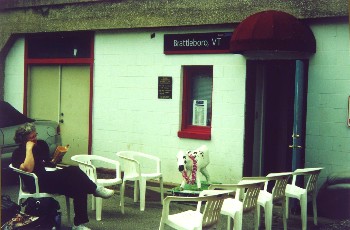 |
| A passenger and Rosie the Calf outside the Brattleboro station. |
You can walk out of the Econo Lodge and into a shopping center next door, or you can cross the street to an outlet center. And you can walk into town. There are sidewalks the whole way—about a mile. That’s Brattleboro, Vt., a city about the size of Fredericksburg but without the suburbs.
My wife and I arrived by train for our son John’s college graduation from Marlboro College, about 13 miles from Brattleboro. What I found in Brattleboro often reminded me of Fredericksburg and invited comparison of the ways for getting around both cities.
Brattleboro, like Fredericksburg, lies next to a river (the Connecticut), has a central train station, light industries and a community college and has a traditionally laid-out downtown that’s about a mile across. It also has an Interstate Highway and roads leading to other towns and to neighboring New Hampshire.
Compared to Fredericksburg, Brattleboro doesn’t have as many tourist attractions, though it does attract visitors. The scenery is pleasant (there’s a waterfall downtown), and there’s some local history to learn about. The intercity bus station is miles from town, out near an exit from Interstate 5 north of the city. There’s one Amtrak train a day to St. Albans, Vt., with a bus connection to Montreal, and a daily train in the other direction to New York and Washington.
But it’s somewhat easier to get around Brattleboro. There seem to be sidewalks everywhere. Although our hotel was next to an exit on the Interstate, we walked to stores, walked to church, even walked the mile to the train station with one suitcase apiece (it was all downhill). The Walk signs are accompanied by a chirping bird sound, which at first I didn’t connect with the traffic signals. The novelty of a bird sound for crossing the street wore off pretty quickly. Downtown Fredericksburg is not too bad to walk around, but generally we are inviting more traffic and congestion by making many places hard to get to without driving.
One place in Brattleboro that had poor access was the train station. The upstairs level of the two-story building fronts on the main street, but it’s now the city museum. To walk to the actual station you must cross a busy street twice, the second time without benefit of a crosswalk or traffic light. Pedestrians clearly were not considered when the railroad part of the building was cut back to the lower level. The Fredericksburg train station is a lot easier to walk to than the one in Brattleboro, though you still have to contend with traffic lights where pedestrians are not part of the equation, and often with motor vehicles parked on the sidewalk. (Unfortunately, Brattleboro, like Fredericksburg, sometimes has sidewalks blocked by parked vehicles. I saw one blind man tapping his way along using his cane. He encountered a van on the sidewalk and found his way around it, but it made me sad to see what we have taken away from some people to make driving and parking more convenient.)
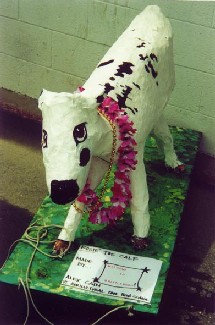 |
| Rosie the Calf. |
But the Brattleboro station has a surprising quantity of amenities for a stop that has two trains a day. There was a waiting room and a clean restroom, plus plastic chairs outside and an entrance graced by a local folk sculpture, Rosie the Calf. The station host (there were no ticket sales) kept the waiting passengers informed as to the progress of Amtrak’s southbound Vermonter (a few minutes late leaving Bellows Falls, the next stop up the line).
This is one area where Fredericksburg should imitate Brattleboro. Far more people spend a lot more time at the Fredericksburg station, sometimes waiting hours for a late Amtrak train. VRE riders or their families sometimes wait there for an hour or more. With hundreds of daily passengers, plus people meeting the trains, Fredericksburg too should have a waiting room and a restroom, as well as a human being to assist people and provide information, instead of loud but indistinct announcements (“Pha-a-ase twoofthe tie replacement program …”). Instead of providing merely a Spartan station, this Southern city should be like Yankee Brattleboro and give passengers a warm welcome and comfortable departure.
[More “Commuter Crossroads”]
[Return to the home page]
How We Got Sprawl
By Steve Dunham
This column appeared in the Fredericksburg, VA, Free Lance–Star on Sep. 4, 2005, and is reproduced with permission.
How did we end up with a highway-dependent development pattern that gobbles open land, neglects downtowns and fills roads to the saturation point? It was encouraged by government policy throughout the past 100 years, according to a book published last year by Oxford University Press. In 20th-Century Sprawl: Highways and the Reshaping of the American Landscape, author Owen D. Gutfreund shows how federal transportation subsidies favored rural highway building over any kind of urban transit or even urban road improvements. He describes the neglect of urban transportation and how the 90% subsidies for Interstate Highway construction prompted sprawl and swallowed states’ transportation budgets.
From early in the 20th century, popular demand for paved roads—at first especially for bicycles, later for automobiles—prompted government spending on improved roads. However, federal highway grants to the states were marked by a restriction that has steered development away from the cities: grants were given almost exclusively for rural roads, and the few that were awarded for urban construction often ended up being spent outside major cities because any town of 5,000 or more qualified as urban.
The funding mechanism, moreover, took money out of the cities and spent it in the countryside. Although organizations such as the American Automobile Association and the National Coalition of Highway Users (companies profiting from the highway industry, not a group of ordinary drivers) opposed requiring motorists to pay any of the costs of road improvements, a significant portion of highway construction was funded by gasoline taxes. However, it taxed urban and rural drivers at equal rates while directing the money primarily to construction outside the cities. The relatively few miles of new highway built within cities often resulted in bulldozed neighborhoods and a flow of traffic that municipalities could not easily absorb, coupled with a demand for parking that took more land off the tax rolls to accommodate auto travel in town. The costs within cities and towns tended to be paid out of general tax revenues rather than any tax related to auto use.
How these policies worked out in practice is shown in three case studies. The author examines in detail how federal highway building affected Denver, CO; Middlebury, VT; and Smyrna, TN. Denver lost business to the hinterlands due to federally subsidized highway and airport construction and saw a marked decline in its downtown. Middlebury, a town of modest size, not only lost business and residents to the surrounding county but could not get state aid for state roads that passed through the town, because matching the federal Interstate Highway grants consumed Vermont’s highway budget; in fact, Vermont could not match all the grants available and so got fewer highways built than it was entitled to. Smyrna, a rural hamlet, got money from Washington in the form of two (and then a third) Interstates, plus a military base. The government-provided infrastructure attracted Nissan and other manufacturers and brought rapid growth and prosperity.
In the 1960s, the wind changed a little bit as urban and some suburban residents began resisting further highway construction, and mass transit, neglected for years as a formerly profitable private enterprise now unable to compete with free roads, began receiving government assistance for construction and operation. States had to choose the smarter policy over the cheaper policy, however, because the federal government continued to pay 90% of the cost of Interstate Highway construction but only 80% for rapid transit.
Nevertheless, it was a turning point. Washington, DC, rejected an inner beltway and began instead to build the Washington Metro—for all its difficulties, still one of the best rail transit systems in the country. Denver managed a downtown renaissance and, in the 1990s, started a light rail system that is still expanding. Dozens of other cities have built new transit lines in the past few decades.
However, highways still get the bulk of the money, and highway expansion, accompanied by continued sprawl, remains the order of the day.
[More “Commuter Crossroads”]
[Return to the home page]
Why Should Taxes Pay for Public Transportation?
By Steve Dunham
This column appeared in the Fredericksburg, VA, Free Lance–Star on May 1, 2005, and is reproduced with permission.
Should local, state and federal taxes pay for public transportation? This question is a hot issue right now. Stafford and Spotsylvania counties have been considering how much (or whether) to fund Virginia Railway Express; the Commonwealth of Virginia is weighing better rail service against more highway lanes to carry truck traffic through the Shenandoah Valley; the Bush Administration wants to zero-out the Amtrak budget and more than double the security fees paid by airline passengers.
Affecting all three issues—and many other budget issues around the state and across the nation—is the question of how much tax money (if any) should go toward public transportation. It’s interesting that it should still be an issue, because transportation has been funded by the government since the early years of this nation, and historically since nations started building roads and canals to facilitate commerce. America’s railroads, canals, and highway network were built with government assistance, and the airlines depended on government money to get started and keep going. Every mode of transportation benefits from some kind of taxpayer funding.
One reason it’s still an issue is something called “user fees”: taxes that are supposed to pay for transportation by charging those who use it. The security fee imposed on airline tickets is one of these. The White House wants to more than double these charges, increasing the amount collected from $2.652 billion in 2005 to $4.1 billion in 2006, according to Aviation Today. Of the $5.2 billion cost of airline security, the proportion paid by air travelers would go from 36% to 73%, according to the Anchorage (Alaska) Daily News. Clearly airline passengers are not paying the full cost of security, nor are rail riders, who benefit from government-funded railroad or transit police forces. Drivers rarely pay directly for police service.
What drivers do pay is a gas tax. The federal gas tax goes into the Highway Trust Fund to build more highways, although states have the option of using the money toward rapid transit or commuter rail (but not intercity rail). The Bush Administration wants to offer states a 50% federal share of funding for intercity rail service, but continue to offer 80% or more for highway construction. This approach is likely—but not guaranteed—to steer states away from rail and toward more highways.
This federal budgetary influence is compounded by a lack of transportation choices, because every purchase of gasoline is treated as a de facto vote for more highways. The “user fee” in the form of the gas tax appears to be based on the assumption that we have chosen to drive rather than use some other means of transportation and that we would like more highways built. In fact, plenty of travelers are driving because their only other choice is to stay home.
Not all drivers want more highways. In the Shenandoah Valley, the state is considering making I-81 an eight-lane road. Many valley residents who drive (there are few alternatives) are up in arms against the highway widening.
Elsewhere, people who live far from an Interstate highway pay a gas tax to build highways they don’t often use. Furthermore, a huge proportion of roads are not federally funded at all. The money comes from state general funds, local property taxes and income and other taxes.
Gas taxes don’t cover all the costs of building roads, and they usually contribute nothing to the other costs of highway travel, such as lower air quality (which we are experiencing in the Fredericksburg area), traffic and removal of land from tax rolls (highways and parking are property gobblers). When we drive, there are many costs we don’t pay directly.
For several decades rail passenger service, especially mass transit, has been getting a bigger share of our tax dollars spent on transportation, though the amount is still dwarfed by what goes to roads.
The reason is that it is in public demand. It facilitates commerce, mitigates traffic and air pollution and gives people a transportation choice. Rail riders, like drivers and airline passengers (and many of us are all three), do not pay the full costs of our transportation.
It’s because of the economy. Airports and highways are frightfully expensive to build and maintain. Just think “Mixing Bowl.” Rail operations are expensive too. But mobility and access are key to the nation’s economy, and they have been since the days of the National Road, the Erie Canal, and the transcontinental railroad. If we want to travel, whether it’s downtown, into Washington or across the country, it’s going to cost us.
[More “Commuter Crossroads”]
[Return to the home page]
Smart Growth May Arrive at Leeland Station
By Steve Dunham
This column appeared in the Fredericksburg, VA, Free Lance–Star on March 20, 2005, and is reproduced with permission.
Imagine getting off the Virginia Railway Express train and walking home from the station, stopping on the way to pick up dinner. Kids are bicycling home from the playground. Neighbors are jogging past, and as the sun gets low, a few history buffs are taking a last look at a Civil War historic site. And you’re not in Fredericksburg. You’re in Stafford at the next expansion of the Leeland Station development.
It will be a village with shops, restaurants, professional offices, apartments and town houses, besides typical suburban homes with lawns, if the property owner’s vision is fulfilled. Ted Smart, manager of Maryland Development Company, wants to “take advantage of the transportation” that’s there—VRE—and “put growth where it’s supposed to go.”
The company already has the right to build another 397 homes on mostly large lots on the undeveloped property at Leeland Station. What Smart wants to do instead is build on a fraction of the land and offer a mix of residential and commercial property—a “free sample” of smart growth, he calls it. Age-restricted duplexes and apartments would complement the town homes, single-family houses and a few villas and estates. Open space would include parks and trails and sports fields.
The proposal has been endorsed by the Smart Growth Alliance, which does not bestow its approval without knowing the facts. Its project recognition jury examined Maryland Development Company’s responses to a 13-page questionnaire before deeming it to be truly smart growth.
What about the rest of the company’s property? If all the homes that Maryland Development is authorized to build are concentrated in a village, building still more homes—an extension of the village—on the remaining land will require zoning changes. But a revised Stafford development plan and any zoning decisions based on it appear to be years away. Smart, however, is confident that if he can go ahead with the first village, the county and its people will like what they see and grant permission for the rest of the property to be developed in a similar fashion. “We’re willing to take that risk,” he said.
Not only would the development buck the trend of sprawl in the Fredericksburg area, but Smart calculates that mixed-use development would give the county a net tax gain—after the cost of providing services to the new community—of $1.6 million a year. As a bonus, the company would construct an additional 150 temporary parking spaces on its land adjoining the Leeland Road VRE station, saving government expense, and “potentially permanent parking in the future”—perhaps doubling the size of the commuter lot in accordance with VRE projections.
VRE was designed mostly on a park-and-ride model. With few exceptions the stations have little access except by car. Accommodating growing ridership means adding parking spaces. Fredericksburg, Quantico and Manassas are notable in that a sizable percentage of local residents can walk to the station. Transit-oriented development at the other stations would move VRE closer to the pattern of many other commuter railroads: in many towns a sizable percentage of the passengers walk to the station. This would help VRE grow at lower cost, providing more transportation without an equal increase in parking.
To take the next step, Maryland Development Company needs a text amendment to Stafford’s building code to allow the homes to be concentrated in a smaller area, with private parking and commercial space. Smart emphasized that what his company is asking of the county is “stricter criteria.” He hopes to get the planning commission to review the amendment in time for the supervisors to approve it in June.
Most current development requires travel by road to go almost anywhere, creating an endless multiplication of traffic and lessened mobility for anyone who doesn’t drive. The proposed village at Leeland Station would take growth in a different direction. It looks like a smart idea to me.
[More “Commuter Crossroads”]
[Return to the home page]
Federal Anti-Amtrak Policy Is Bad for Virginia
By Steve Dunham
This column appeared in the Fredericksburg, VA, Free Lance–Star on Feb. 20, 2005, and is reproduced with permission.
Two weeks ago, the Bush Administration proposed eliminating Amtrak’s operating funds except for trains on the Northeast Corridor between Washington and Boston. This latest effort to eliminate or drastically reduce federal spending on passenger trains reflects an attitude that Amtrak has “unsustainably large operating losses,” in the words of Kenneth Mead, the federal Department of Transportation’s inspector general, in a Nov. 18, 2004, memorandum.
This sort of talk suggests that operating passenger trains around the country (with generally sparse service outside the Northeast) is costing the taxpayers dearly. Just how big is this financial burden?
In fiscal year 2005, Amtrak is getting $1.2 billion in federal money. To me, this is a lot of money, but I am not personally providing transportation alternatives for 25 million passengers a year. In fact, compared to what Amtrak was getting only a few years ago, it is a lot of money. Until David Gunn became Amtrak president in 2002, the national passenger railroad never got as much as a billion dollars in a year. Gunn “implemented a strategy of maintaining and building the existing Amtrak system,” again in the words of inspector general Mead. Gunn also told the president and Congress that operating Amtrak at a profit was a fantasy, no matter what the previous Amtrak presidents had said, and that the rail system had been so severely underfunded that he would have to shut it down unless it got adequate funding immediately.
After two years at the helm, Gunn stated that even $1.2 billion a year isn’t enough to pay for essential capital investment. Amtrak owns and maintains most of the 451-mile Northeast Corridor. A lot of the electric power system dates to the 1930s. The tunnels are even older.
Gunn is an experienced, no-nonsense railroader who has been putting Amtrak’s operations and finances in order. But he cannot feed five thousand people with a few loaves and fishes, nor move 25 million people with what, to you and me, seems like a lot of money but is in fact just enough to keep things from falling apart.
Eliminating Amtrak operating funds outside the Northeast would certainly drive away David Gunn, the most capable manager Amtrak has ever had. It would also be a slap in the face to the states that Bush says should be paying for train service. The Commonwealth of Virginia appropriated $66 million to decrease congestion and shorten trip times between Washington and Richmond. Many states have been spending money to pay for Amtrak service, to improve Amtrak facilities, or both. Now they would see their investments lost. Do you think they will step forward again to pay for federally sponsored rail passenger service?
States would not only see their investments lost, they would have to start paying for Amtrak stations that also host commuter services but would now be abandoned by Amtrak: Chicago, Los Angeles, San Diego, Seattle, and Dallas come to mind, and here in Virginia, Alexandria. In Richmond, Main Street Station does not host commuter trains, so it would stand empty scarcely a year after being beautifully refurbished.
Eliminating money for Amtrak operations in Virginia and the rest of the South—and the Midwest, the Southwest, and the Northwest—would not just be pound foolish, it is not even penny wise, because what we spend on Amtrak is not one cent out of the federal tax dollar. It is not even close. It is not even 3% of the $57.5 billion Transportation Department budget.
A few weeks ago I wrote to Rep. Jo Ann Davis and said that if our transportation spending is intolerably high, we should cut the highway and aviation budgets 10% each and double what we spend on Amtrak. I was wrong. It would not require 10%. The Bush budget proposes $35.4 billion for the Federal Highway Administration. This one-year appropriation would be more than Amtrak has gotten in its 34 years of existence, according to Norman Mineta, the federal transportation secretary, although he gave those numbers while saying that Amtrak’s operating losses are “unsustainable.” Bush also proposes $14 billion for the Federal Aviation Administration.
Amtrak doesn’t need 10% of that money. Less than 5% of it would be enough to double Amtrak’s budget and remedy the one thing about Amtrak that really is financially wasteful: running skeletal service to major cities. The answer is not to eliminate Amtrak trains to cities such as Atlanta, which sees only two trains a day, or to Houston, which has only six per week. The answer is to give Houston and Atlanta (and Newport News and Charlottesville and Lynchburg) six trains a day. The stations and personnel are already there. The cost of running trains will go up somewhat. The cost per passenger will plummet.
Instead of cutting an Amtrak budget that would barely fund the Pentagon for one day, let this be the last time any politician mentions the high cost of Amtrak. Let this be the resurrection of good, frequent passenger train service throughout the United States. Give Amtrak the money while it has a leader like David Gunn to spend it wisely. A billion or two per year is not a burden on America. It’s the present federal transportation policy that is unsustainable.
[More “Commuter Crossroads”]
[Return to the home page]
Community Action Gains Transportation Choices
By Steve Dunham
This column appeared in the Fredericksburg, VA, Free Lance–Star on Nov. 28, 2004, and is reproduced with permission.
How does a small city establish safe walking and biking routes, expand public transportation, and get people of all ages informed and involved? In Charlottesville, it’s happening with community action, thanks to the Alliance for Community Choice in Transportation, a grassroots volunteer group founded in 2001.
Its first project was Safe Routes to School, organizing opportunities for children to walk or bike instead of riding in a car or bus (“Kids walk to school for fitness,” Free Lance– Star, Nov. 14). With that program thriving, the alliance has taken on other projects that likewise could offer a model for Fredericksburg.
“Much of the small town civility that Charlottesville once knew seems endangered today, as traffic congestion grows and more of us find ourselves in a hurry,” according to the group’s September newsletter. Pedestrian Safety Month was one response by the alliance. During September, volunteers handed out flyers to educate the public about pedestrians’ and drivers’ responsibilities and carried placards in crosswalks to remind drivers to yield to pedestrians. The city police agreed to enforce the pedestrian safety laws at crosswalks and intersections.
Another of the alliance’s ideas is a streetcar line—a real electric trolley running on rails in West Main Street. It could provide additional transit capacity, encourage the downtown area’s economic vitality, and draw outside tourists to the city. Recognizing that a trolley line would represent a major civic investment, the Alliance for Community Choice in Transportation is doing some serious work. Earlier this year, with a grant from the Blue Moon Fund, the alliance took 20 influential people from Albemarle County and the City of Charlottesville—including the mayor—to the West Coast to see modern urban trolley systems in Portland, Oregon, and Tacoma, Washington, according to Alia Anderson, executive director of the alliance. In August, Roger Millar, of the DMJM + Harris transportation consulting firm and a key person in establishing Portland’s trolley line, came to Charlottesville for a technical look at the proposed trolley line. He examined route location alternatives, infrastructure changes needed for a trolley line, and possibilities for transit-oriented development.
The alliance has a close relationship with Charlottesville Transit Service, working as partners with the service at public events such as the bike rodeo and making recommendations to improve the bus service.
Working with public, civic and volunteer organizations, the Alliance for Community Choice in Transportation has become a clearinghouse for information on transportation choices. Through its Community Resource Center, the alliance provides “answers, solutions and options,” said Anderson. The alliance sees itself in an educational resource role, she said, and it offers assistance and transportation information by phone, via its website, and with an impressive achievement, the Charlottesville Area Regional Mobility Map. Sponsored by and distributed through area businesses, this is a first-rate job. It shows all the bus routes, bike lanes, preferred bike routes and walking trails in Charlottesville. The phone numbers, websites and general operating hours are listed for every bus service in the area, along with information about parks, recreation, safety and how long it takes to make typical walking, biking and bus trips in the area. The sponsoring businesses have advertisements in the border and are indicated by numbers on the map. I’ve been to Charlottesville by train and by car, and I had some trouble finding my way around. With this map in hand, I wouldn’t hesitate to go there and walk around town, ride the local buses and patronize the sponsoring businesses—and thank them for this wonderful package of information.
We could use a map like that for Fredericksburg, with one addition: show where there are sidewalks, where there aren’t and where there are hazards to walking, like the Blue and Gray Parkway or the vehicles that routinely block the sidewalks on Lafayette Boulevard—both are obstacles to anyone visiting and exploring the battlefield on foot.
Community action has achieved a lot in Charlottesville, and it could do a lot in Fredericksburg. “Everything we do relies strongly on volunteers,” said Anderson. “We’re a small organization, but we get a lot done.”
[More “Commuter Crossroads”]
[Return to the home page]
Lack of Transport Choices Hurts the Elderly
By Steve Dunham
This column appeared in the Fredericksburg, VA, Free Lance–Star on Aug. 22, 2004, and is reproduced with permission.
Have you thought about how you will get around after you retire? Most Fredericksburg-area residents already cannot get very far without a car. If you live in the sprawl of Spotsylvania, Stafford and other nearby counties, as so many of us do, just getting to Fredericksburg and back without a car is an achievement.
Sometimes I get off the train in Fredericksburg and have no ride home and no car available. Riding the Fred bus halfway and walking the rest, I can get home in an hour and a half. Going nine miles without a car is an accomplishment. For almost all of the hike, there are no sidewalks. Walking on the shoulder of U.S. 1, I repeatedly step off the road into the weeds, gravel or mud to yield to motor vehicles. Still I get honked at and yelled at by drivers who seem to resent the presence of a pedestrian.
I may not be able to travel those nine miles without a car if I live to be 80, and chances are good that I won’t be driving then either. One in five Americans age 65 and older do not drive, according to “Aging Americans: Stranded Without Options,” a report published this spring by the Surface Transportation Policy Project. Declining health and concern over their own driving ability keep some from driving. “No car” is another reason, and if I’m living on Social Security the chances are excellent that I won’t have money for a car. “Personal preference” is another reason cited in the report. I can understand this. I’m already sick of being on the road with red light runners, stop sign runners, speeders and tailgaters.
So what choices do older Americans have? “Over half of non-drivers aged 65 and over stay home on any given day.” Furthermore, “African-American, Latino, and Asian-American elders are disproportionately affected by the lack of options,” as are people in rural areas.
In some areas, though, the elderly have a lot more mobility. Where public transportation is available, they use it. If there are safe places to walk or ride a bike, they will walk and, yes, ride a bike. In the Netherlands, where bicycles are a popular means of transportation, nearly half of all trips made by people aged 65 and over are made on foot or by bicycle, the report noted. Safe places to walk and bike would contribute not only to mobility but to health, says the report, citing figures from the Surgeon General and the Centers for Disease Control and Prevention.
More public transportation and safe places to walk and bike would contribute to health and mobility for a lot of people, not just those of retirement age. There are plenty of people under 65 whose health, driving ability, and lack of a car keep them from driving.
And then there’s personal preference. Where they have transportation choices, a lot of people use them. Just look at how many commuters in this area take public transportation to work if it is available. Many—I assume most—of them could drive, but when they have a choice, they choose not to.
I don’t buy the story about America’s love affair with the automobile. Yes, there are people who love cars, and there are people who love trains. But most of the people riding Virginia Railway Express are not using it because they love trains, and most of the people on I-95 are not there because they love cars.
With government transportation spending vastly favoring highways over anything else, and with development patterns, noticeably in the Fredericksburg area, generally discouraging travel except by car, Americans aren’t having a love affair with cars. It’s a shotgun marriage.
So where will you and I be in 10, 20 or 30 years? Sure, I would like to spend more time at home, but I don’t want to be stuck at home. Will we have more choices than we do today, or will we pass each other while walking on the shoulder of the highway?
[More “Commuter Crossroads”]
[Return to the home page]
Commuting the Last Mile
By Steve Dunham
This column appeared in the Fredericksburg, VA, Free Lance–Star in slightly different form on July 25, 2004, and is reproduced with permission.
In commuting, sometimes the last mile is the hardest. For some Fredericksburg-area commuters, the last mile got a little harder starting July 1, when Virginia Railway Express passengers lost their free transfer to Alexandria Transit (“Dash”) buses.
Ever since my employer moved miles away from any rail station (the company used to be an 8-minute walk from the Crystal City station), traveling the last 4 miles to work has been the most difficult and time-consuming part of the commute. The company shuttle bus does go to Crystal City three times each rush hour but just misses the evening Fredericksburg trains. There’s also a Metrobus that runs every half hour and leaves just about when VRE is arriving. But with a 12-minute walk between King Street and Braddock Road in Alexandria, I used to have a choice of two Dash bus routes and one Metrobus route, with eight buses per hour. It still took about 40 minutes to travel the last 4 miles to work, but that’s better than waiting up to half an hour for the next bus.
Other commuters traveling to work or school in the Alexandria area also found their choices slashed. VRE needed to balance its budget and decided to stop paying for bus connections (Metro doesn’t charge VRE for passengers who transfer to its buses). As a result, traveling by public transportation in Virginia just got slower and more expensive. For an area with few transportation choices, severe traffic congestion and deteriorating air quality, that’s bad news.
The good news is that we do have bus connections. Our transportation system was planned so that drivers could get almost anywhere. Everything else—public transportation, places to bike, places to walk—is mostly piecemeal, and the pieces are not necessarily designed to connect with one another.
Hank Dittmar, president of Reconnecting America, discussed this problem at the Transportation Connectivity Symposium in Farmington on June 4. He wants to “create a ‘Last Mile’ Intermodal Connections Program to eliminate bottlenecks for passengers and freight by funding intermodal terminals at airports and downtown hubs and incorporating intercity rail and bus and local transit.” In Fredericksburg, this might take the form of one station for VRE, Amtrak, Fred, Greyhound and commuter buses. Fred Central would be at the railroad station, and the buses would run often enough that you could get off the train and expect a bus for any line to depart within, say, 15 minutes. Since walking to the farthest VRE lot already takes about 8 minutes, this would provide an attractive alternative to many of the people who are now driving to the station.
In Washington, reconnecting transportation with a “last mile” project would probably mean putting the bus terminal next door to Union Station instead of several blocks away. In Alexandria, it could mean routing all bus lines through King Street station (served by Amtrak, VRE, and Metrorail); most buses go there already.
These places already have some kind of connectivity, but it often involves transfers that require time and money to travel a short distance, whereas more intermodal hubs would make public transportation faster, simpler, and cheaper.
The more transfers you have to make, the slower your average speed, and if the transfers cost money, your cost per mile is probably going up too. Public transportation is already attracting a lot of riders, but as we build a transportation system for the future, we need to create one that rewards travelers who choose alternatives to driving. That means making it easy for them to travel the last mile.
[More “Commuter Crossroads”]
[Return to the home page]
Connecting Virginia’s Separate Transportation Systems
By Steve Dunham
This column appeared in the Fredericksburg, VA, Free Lance–Star in slightly different form on June 13, 2004, and is reproduced with permission.
Virginia has highways, passenger trains, rapid transit, bus lines, freight railroads, airports, ports and biking and hiking trails. Most were designed without considering all the others. Sometimes they cooperate. Often they compete. Never are they all designed together as an integrated transportation system.
In Fredericksburg, for example, we have Fred, with its central transfer point at the Greyhound station—a reasonably convenient connection that I have used a few times. Two Fred routes also serve the railroad station downtown, but the first Fred bus arrives downtown after the last Virginia Railway Express train has left. You can use Fred to get to and from some Amtrak trains, but in the evening the trains keep arriving after the last Fred bus has gone, except for the weekend-only (but not in summer) Fred Express.
The National Coach Lines buses stop at the commuter parking lot on Route 3, which is not directly served by Fred, and again Fred doesn’t reach the area until the last bus has departed in the morning.
Walking or biking to VRE is possible, but few safe walking or biking routes go very far from the stations. Within the city, walking is possible to most of the Fred routes; outside the city, Fred generally deposits you in an area without sidewalks. Walk or bike to the commuter parking lot to board a bus? You weren’t part of the equation when the system was designed.
What about the 500-pound gorilla in our transportation system, the automobile? Yes, it sits anywhere it wants, but nowadays it’s doing a lot more sitting, and it’s having trouble finding a place to park, too. Even with the automobile’s ubiquitous and generally preferential access to almost everywhere, access is a growing problem, even when another mode of transportation is used to complete the trip. You can drive to the commuter parking lot to catch a bus, and you can drive to a VRE station and maybe find a place to park, but parking at the Greyhound station is scarce, and driving to one of the region’s airports is something to be dreaded.
Clearly, the designers of all these systems gave at least some thought to the others, but each system was planned individually, with some connections at some points, not to give people the widest range of transportation choices.
But is there a better way? That was the question at the Transportation Connectivity Symposium, sponsored by the Virginia Rail Policy Institute and held on June 4 in Farmington, outside Charlottesville.
The keynote speaker, Hank Dittmar, who is president and chief executive officer of Reconnecting America, argued that the United States has concentrated on expanding single-mode networks, with stove-piped planning, funding, and delivery of service. Transportation policy, he said, focuses on “projects, not performance.” He also maintained that emphasis on “mobility” is misplaced. Transportation, he said, is about “access for people and goods.” If you walk to an automated teller machine, that may serve the same purpose as a trip to a bank, he pointed out. What our transportation system needs to do, he said, is provide access to markets, jobs, recreation, and other things.
Throughout the symposium, dozens of speakers and panelists talked about identifying obstacles to connectivity and finding solutions. Access to the Jamestown 2007 events was noted as a problem with a looming deadline, and in other areas, transportation funding is scarce even for maintenance, much less improved connectivity. But there were reasons for hope, too, and I plan to discuss some of them in future columns.
[More “Commuter Crossroads”]
[Return to the home page]
Missed Opportunity at Main Street
By Steve Dunham
This column appeared in the Fredericksburg, VA, Free Lance–Star on Dec. 14, 2003, in slightly different form and is reproduced with permission.
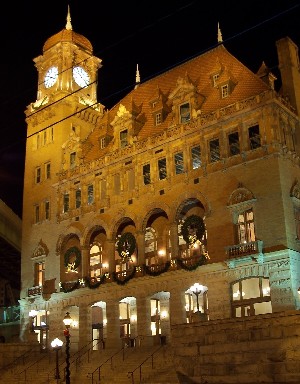 |
| Photo courtesy of Mike Testerman, copyright 2003 |
Main Street Station in Richmond reopened December 18, giving the city a passenger train station within the city limits for the first time in 28 years. The station is on the eastern edge of downtown, close to the Shockhoe Slip area of restaurants, the Medical College of Virginia, and one end of the canal walk. The state house is about six blocks away.
Initially the station will be served by a pair of trains in each direction (north and south), with a third southbound train on weekdays. The station is on the route of Amtrak’s trains to and from Williamsburg and Newport News. Further work on the station and tracks south of it will allow the Amtrak trains that terminate in Richmond, the daily train to and from Charlotte, and the Florida trains to use the station. All of these except the Florida trains also stop in Fredericksburg.
Main Street Station has been nicely renovated; it’s a Richmond landmark dating to 1901, beautiful to look at except that I-95 passes uncomfortably close by on a viaduct just before crossing the James River.
Passenger trains once served both Main Street Station and Broad Street Station. Although Main Street and Broad Street are only three blocks apart, the stations bearing their names are at opposite ends of downtown Richmond. In 1975, Amtrak closed both stations and moved to a station on Staples Mill Road in Henrico County. This station, called “Richmond,” is about five miles from downtown. It remains in use. The Broad Street Station now houses the Science Museum of Virginia. Main Street Station housed a shopping mall and later some state offices, but often it was vacant and quietly decaying. It’s nice to have it back.
It’s a big step forward to have a train station serving downtown Richmond, making it much more accessible as a destination by rail. For business and government travelers from Washington, Baltimore and points in the Northeast, the direct service to Main Street may now look a lot more attractive than a flight to the airport in Sandston, east of the city.
What Main Street Station doesn’t offer yet, however, is attractive rail travel for shorter trips from Ashland and Fredericksburg. First of all, the fares may be competitive with flying, but they aren’t competitive with short-distance driving. A one-way ticket from Fredericksburg to Richmond is about $25, approximately 50 cents a mile. That’s awfully steep.
Between Richmond and Ashland, the one-way fare is $16, almost a dollar a mile. Amtrak is offering a ten-ride ticket, valid for 45 days, for $54 (about 18 cents a mile), and a monthly ticket for $161 (less than 12 cents a mile).
A few weeks ago I helped host an information display at the Ashland library’s Train Day. I heard from people who had been hoping that once Main Street Station opens, they could use the train to commute to work in Richmond. The multiple-ride fares are not prohibitive, but an Amtrak schedule change this year reduced the time you could spend in Richmond. Now the first train doesn’t get to Richmond till after 10:30, and the last one north leaves before 4:00, effectively ruling out commuting anyway.
I realize that Amtrak is an intercity carrier, not a commuter railroad, and the company wouldn’t want to fill seats with short-distance travelers buying cheap tickets if they were displacing more lucrative fares between, say, Richmond and New York. However, I often see trains 76 and 77, which operate between Washington and Newport News, going by with quite a few empty seats—unlike last year, when those trains operated all the way to Boston. Amtrak could use its online Rail Sale to offer a few seats per train at cheap prices, as it does with other trains when they have unsold seats. If I could get a $20 round trip by train to Richmond, I would go there for the day with my wife. Selling just a few seats cheaply would fill some empty ones, not cut into Amtrak’s longer-distance business.
Better yet would be for the Commonwealth of Virginia to fund one Virginia Railway Express train between Fredericksburg and Richmond. If it were scheduled around working hours at the state offices, just one train could serve a lot of the working population. It would give a lot of people a commuting alternative to driving and ease the rush-hour traffic and parking crunch in Richmond. Ironically, a reduction in parking space for state workers was one cause of delay in reopening Main Street Station. Now that the station will be open, how about giving those workers not just a place to park, but a better way to get to work?
[More “Commuter Crossroads”]
[Return to the home page]
The Third Choice
By Steve Dunham
This column appeared in the Fredericksburg, VA, Free Lance–Star on July 13, 2003, and is reproduced with permission.
For most trips—to work, to shopping, to church, for recreation—people in the Fredericksburg area have two choices: drive or stay home. This is especially true in the suburban and rural areas of the surrounding counties.
Most roads have been built without sidewalks, most traffic lights leave pedestrians out of the equation and most stores, at least in the suburbs, are accessible only by road. Even neighboring stores often have curbs, fences or other barriers that prevent people from walking from one place to another.
For a few trips, some people have transportation alternatives such as Fred, Virginia Railway Express, bicycling and walking. But even the VRE stations in Stafford have been designed in a way that discourages people from arriving by bicycle or on foot.
Our local transportation alternatives are not likely to make much of a dent in traffic, except on I-95, which might be at a standstill more often if the parallel VRE service were not carrying such a large volume of north-south passengers. What our transportation alternatives are doing is—sometimes—to give people a third choice other than driving or staying home.
We have an opportunity, and I would say an obligation, to give people more transportation choices. Let’s first of all recognize that a lot of people don’t have two choices: they are too young, too old, too poor or not healthy enough to drive. To these people—and there are many of them—and to the thousands of other people who would not add traffic to the road if they had an option—we owe a third choice.
Look at the traffic congestion in the Central Park shopping center, for example. It has become notorious. The area was designed in a way that discourages people from walking there even if they live nearby, and it discourages people from arriving by bicycle. Furthermore, it is so spread out, with acres of parking lots separating many stores, that it encourages people to drive from one place to another even within the shopping center. The Fred bus service to Central Park runs at most once an hour, and not at all on summer weekends.
This shopping center may never be able to overcome its highway orientation, but we could make it an easier place to get to: First, build a pedestrian and bicycle bridge over Route 3. Second, add exclusive pedestrian signals to the traffic light cycle. Third, run the Fred bus every fifteen minutes. A lot of people will use transit to go shopping if it’s frequent and convenient. Just look at Pentagon City. The other Fred routes (which generally run at most every two hours) have a lot of untapped potential too.
Another choice that should be expanded is Virginia Railway Express. It is already strained by the number of people wanting to ride, and that’s just with a weekday rush-hour service. Despite the limited choices of departure and arrival times, every day you can see people taking the train to National Airport, the museums in Washington, and even (with a change of trains at Washington) Baltimore-Washington International Airport. With hourly service to Washington and Richmond seven days a week, we would find people riding the train to a lot more places, including Fredericksburg.
The people of this area deserve a third choice for their other trips too. When a new retail, office, or housing development is proposed, our local governments should be asking, “What will you do to encourage people to get to and from your development without driving?” Will there be pedestrian and bicycle access to nearby housing, retail, and employment centers? Will there be transit access?
We also need to remedy the way that transportation alternatives have been designed out of our present system. If every traffic light had a button that would trigger an exclusive pedestrian light, people could get around the Fredericksburg area much more safely. If no pedestrians are waiting to cross, traffic won’t be delayed. People who do want to cross will not have to compete with turning traffic.
There are countless trips that are overdue for a third choice. The improvements will cost money, yes. The system we have now cost a lot of money to build, and we are still paying in other ways. When people have more choices for every trip—drive, stay home, walk, bicycle, take a bus, or take a train—the Fredericksburg area will be growing into a place that is more attractive to live, shop, and work. That will be good for the economy, good for the people who visit, and good for the people who live here.
[More “Commuter Crossroads”]
[Return to the home page]
Cardinal Sins and Cardinal Virtues
By Steve Dunham
This column appeared in the Fredericksburg, VA, Free Lance–Star on April 6, 2003, and is reprinted with permission.
Amtrak’s Cardinal flies through Virginia Railway Express territory, and far beyond, six times a week. Two rides on the Cardinal this year and two last year gave me a look at the train and how it serves the transportation market—sometimes poorly, sometimes well.
The Cardinal operates between Washington and Chicago via Manassas, Charlottesville, Charleston, Cincinnati and Indianapolis; it is named for the state bird of all six states through which the train runs. The Cardinal departs and arrives Washington on Sunday, Wednesday and Friday. Yes, the train runs only three days a week. VRE passengers with ten-trip or monthly tickets can ride the train anywhere between Washington and Manassas. As such, the Cardinal provides a modest supplement to the VRE service. Its main role in Virginia, however, is to serve the towns and cities farther from Washington: Culpeper, Charlottesville, Staunton, Clifton Forge.
The Cardinal’s main sin is that it doesn’t run every day. Beyond Charlottesville and all the way to Chicago, it is the only train on the route. This means that travelers to and from Charleston, Cincinnati and Indianapolis and the towns along the way have very slim choices about when to depart and when to return.
The Cardinal’s other big sin is that it is often late—very late. When my son James and I rode the Cardinal to Chicago this winter, we passed the eastbound Cardinal somewhere in West Virginia, and I estimated that the train was four hours late. “How does a train become four hours late unless there is a derailment or a detour somewhere?” I wondered. We soon found out. We lost hours switching cars (mostly waiting to switch cars) at Indianapolis, and in northern Indiana, the CSX signals were out of order, and we had to proceed at 30 miles per hour for a long way. By the time we reached the suburbs of Chicago, we were over four hours late. Coming home, we were an hour and a half late. This unpredictability makes the Cardinal just about useless for local travel. You can take the train to Charlottesville for the afternoon, but who knows when you’ll get home?
The Cardinal, I’ve heard, is a political train—a bone tossed to the politicians of West Virginia and other states so that their constituents have some train service. The pols, it seems, don’t have enough clout, or don’t care enough, to get some good train service for their people—like a train that runs every day and on time.
The Cardinal may be infrequent and often late, but for all that, it does carry a good number of passengers. I’ve been on board when it was sold out. On my trips this winter, there were a lot of people in coach, and the sleeping car was sold out. Maybe if you live in Clifton Forge, Va., Huntington, W.Va., or Hamilton, Ohio, there aren’t a lot of other choices. But there were a lot of people taking the train to Indianapolis, too, even though the train stops there in the wee hours.
The Cardinal does have its virtues, especially the scenery. It crosses the Blue Ridge from the Piedmont to the Shenandoah Valley. On any Sunday afternoon, you’ll see people boarding the Cardinal in Charlottesville for a ride over the mountains to Staunton and back. It follows the New River Gorge in West Virginia—a place of amazing beauty, where a historical society runs special trains just for people to see the gorge.
The train also makes connections at the ends of the trip for points beyond. On the days I rode, a lot of the Hoosiers and Ohioans and Kentuckians and West Virginians were traveling not just to Chicago or Washington but to Minneapolis or St. Louis or Philadelphia or New York.
The Cardinal may be at risk because it’s hopelessly uneconomic. No matter how many people ride, it can’t pay for big-city stations that don’t even have a train every day. I think the answer—economically and to provide real transportation service to a lot more people—is to run the train every day and on time.
And even the way it is now, even if it runs late, you might find a trip on the Cardinal an enjoyable way to travel. The schedule and fares (and sometimes Rail Sale reduced fares) are on the Amtrak website at www.amtrak.com.
[More “Commuter Crossroads”]
[Return to the home page]
Waving at Trains
By Steve Dunham
This column appeared in the Fredericksburg, VA, Free Lance–Star on January 26, 2003, and is reprinted with permission.
“Do people who wave at trains/ Wave at the driver, or at the train itself?” asked Roger McGough in his poem “Waving at Trains.” “Or, do people who wave at trains/ Wave at the passengers? Those hurtling strangers,/ The unidentifiable flying faces?”
In the winter, riding Virginia Railway Express, I don’t see many people waving, but much of my ride is in the dark, and fewer people are outside in the cold weather. A certain group is out before sunrise every morning, though: the Marines at Quantico. One morning, a few of them turned from their work and waved at the train as it went by. This got me thinking about waving at trains.
After some reflection, I decided that people are waving at other people, not at the train itself. When a freight train goes by, we’ll wave at the engine but not the freight cars. When Amtrak’s Auto Train goes by, we wave at the passenger cars but not the string of auto carriers. Waving is a greeting to the people on board.
Usually the engineer will wave back. When I was a kid, that gave me a little thrill. “I have many happy memories of running down to the road to wave to the trains,” said Meredith (Linman) Rolfe. Along with a childhood photo of her, her words are engraved on a historical marker along the Northwestern Pacific line in California.
“I seem to be the last grown-up waving at trains,” wrote another Californian, Miv Schaaf, in her article “Days of Little Red Wagons,” published in North Coast Journal. No, Ms. Schaaf, you’re not. Although adults may cherish childhood memories of waving at trains, people of all ages do it.
It’s a part of our culture. Waving at trains was featured in a novel, The Trains, by Robert Aickman, and it inspired the name of a punk band, Waving at Trains; one of the band members used to be an engineer.
A real-life waving experience inspired Alejandro Escovedo’s song “Wave”: Escovedo’s father, at the age of 12, left his grandparents’ home in Mexico to look for his parents in the United States. “When my dad was leaving, he looked out the window, and his grandparents, who had been taking care of him, were waving and smiling at the train,” Escovedo explained to Michael Corcoran of the Austin, Tex., American-Statesman. “He thought they were waving at him personally, but they didn’t know he was on the train.”
I think that Escovedo’s story explains something more about waving. We’re not just waving at McGough’s “hurtling strangers.” We’re waving to somebody, even if we don’t know who it is. It might be a friend or a future friend. The wave is a gratuitous greeting to anyone who will accept it.
“They must think we like being waved at …” McGough’s poem continued, “But most of us are unimpressed.” I’m one of those who likes being waved at. Sometimes, from my seat on the train, I will wave back, even though the people outside probably can’t see me.
“And yes I think I’m invisible …” wrote Nick Spice in another poem called “Waving at Trains.” “You always smile and then you’re gone,/ Waving at trains.”
[More “Commuter Crossroads”]
[Return to the home page]
Fredericksburg Must Get Ready for Growing Rail Service
By Steve Dunham
This column originally appeared in the Fredericksburg, VA, Free Lance–Star on Dec. 29, 2002, and is reproduced by permission.
The growing number of rail passengers using the Fredericksburg station is straining capacity, but there’s more to come. Even as Virginia Railway Express barely keeps up with the increase in riders, working to provide parking spaces and seats for all its passengers, Amtrak is carrying more passengers to and from the area and is likely to carry even more in the next year.
Only a dozen years ago, Fredericksburg was a flag stop for Amtrak. Trains stopped here only if someone was visible waiting on the platform or if someone on board had a ticket to Fredericksburg. Otherwise the train could roll on through. All the same, in those days before VRE, Amtrak was carrying commuters to northern Virginia and Washington.
Now Fredericksburg is a regular stop for Amtrak, and passengers—sometimes crowds of them—get on and off every train. A year from now, we can expect to see Amtrak once again carrying Fredericksburg-area commuters on a route that has no commuter trains: to Richmond. The Amtrak “Richmond” station on Staples Mill Road is actually in Henrico County, miles from downtown. However, work on reopening Main Street Station is nearing completion, with service tentatively scheduled to begin in October 2003. This historic station is within walking distance of the state house, downtown offices, the canal walk, and restaurants. It will make Richmond an easier place to reach by rail, and Amtrak is sure to attract riders, including commuters, from this area.
Furthermore, the Southeast high-speed rail project is inching forward, as Virginia, North Carolina, and other states work to establish 110-mile-per-hour train service between Washington, D.C., and Charlotte, N.C., and cities beyond.
These added train services will give area residents more transportation choices, and a lot more of them will choose the train. Access to the train station promises to be a problem, however.
Station development is all about mobility, according to Pat McCrory, mayor of Charlotte, who spoke at the Rail-Volution conference in Washington, D.C., in October. Charlotte is creating a light-rail transit system and is confronting the question of how to provide smooth, convenient access to and from the system. This does not necessarily mean lots of parking. In fact, of the 15 stations, 8 will have no parking at all. McCrory said that Charlotte is promoting walking, bicycling, and transit connections. In studying other cities, said McCrory, he has been to stations that have no sidewalks at all. If you arrive at the station by train and try to walk anywhere, he said, you end up walking in the drainage ditch. This is the case at VRE’s stations in Stafford and even if you walk very far from the Fredericksburg station.
To avoid that situation, Charlotte’s designs for new streets emphasize sidewalks, bike lanes, and connecting streets. McCrory sees the standard city grid pattern as helping people choose a convenient route, whereas isolated subdivisions discourage walking and cycling because the street pattern forces people onto roundabout routes. Charlotte is permitting no new cul-de-sacs.
Fredericksburg, Spotsylvania and Stafford could do a lot more to encourage walking, bicycling, and transit use, but we need more parking too. Many rail travelers live 5 or 10 miles from the station. Jeffery Tumlin, a transportation consultant from San Francisco, also spoke at Rail~Volution, and he discussed the way transit systems make decisions about parking. Surface parking is cheap, he said, if you ignore the land value. For transit agencies, he said, land is free and capital is free. He estimated the operating or maintenance cost of one parking space as $1 a day. If land value were measured, he said, the cost would be $8. In his opinion, that makes the real cost of surface parking so high that it should be used only as a land bank for future development. In contrast, if the full cost of parking is considered, feeder transit looks cheap.
Our region needs to decide where and how to add parking and how to give people attractive alternatives for reaching the rail stations. To avoid paving many more acres, this may mean parking garages at the stations; attractive, safe walking and cycling routes; and frequent local transit service, such as Fred buses running every ten minutes instead of every hour or two. These alternatives will give people improved commuting choices whether they work in Washington or in downtown Fredericksburg.
[More “Commuter Crossroads”]
[Return to the home page]
Smart Growth Needs Smart Transit
By Steve Dunham
This column originally appeared in the Fredericksburg, VA, Free Lance–Star on September 1, 2002, and is reproduced by permission.
“You can’t have smart growth if you have dumb transportation,” said G. B. Arrington, chairman of the American Public Transportation Association’s Land Use and Development Subcommittee, speaking at the association’s rail transit conference in Baltimore in June. “Smart growth means transit-oriented development.”
Transit-oriented development—planned growth that emphasizes mass transit as a transport option—is sorely lacking in the Fredericksburg area. One reason is that there is no local transit service worth building around. Yes, we have the Fred bus service, but most routes run every two hours and not at all on weekends: better than walking, but not frequent enough to be an attractive alternative to driving. Virginia Railway Express offers a good choice for weekday rush-hour trips to northern Virginia and Washington, and has indeed sparked housing construction near stations such as Woodbridge and Lorton. However, VRE does not serve the Fredericksburg area as a destination, and that makes the equation more difficult.
Much of the area lacks access by public transportation. People do take Amtrak, Fred and Greyhound to Fredericksburg, and the railroad station is well located for visitors. But if people take the train to Stafford, where would they go after arriving at Leeland Road or Brooke? The VRE service at these stations is designed for people driving to and from the station, not to serve the community as a point of departure and arrival.
Arrington explained part of the solution: we not only need transit-oriented development, we need development-oriented transit. But instead of smart transit, he said, we sometimes have dumb transit. As examples, he mentioned parking that separates a station from the community or a lack of pedestrian access. The stations at Brooke and Leeland Road are examples of the latter: there are homes within walking distance of the stations, but the roads have no sidewalks. They are designed only for drivers. That’s dumb transportation; an extra yard of concrete at the side of the road would create a second transportation choice, and an extra yard of asphalt for a bike lane would create a third. They would not serve a lot of people, but they would be easy and cheap and would slightly reduce traffic, pollution and the need for parking.
What would smart growth look like in the Fredericksburg area? The Smart Growth Network states principles for development: create a range of housing opportunities and choices; create walkable neighborhoods; encourage community and stakeholder collaboration; foster distinctive, attractive places with a strong sense of place; make development decisions predictable, fair and cost effective; mix land uses; preserve open space, farmland, natural beauty and critical environmental areas; provide a variety of transportation choices; strengthen and direct development towards existing communities; and take advantage of compact building design.
Picture a shopping center that is not an island in a parking lot. It has parking, but on one side only. The other side faces a town square, with office buildings, government buildings, a library, and churches and hundreds of homes within half a mile. On the fringe, but within walking distance of everything, is the VRE station, with parking beyond it. Lots of the residents can get to work, church, the library, the park, and the train station without getting into a car. Instead of development that makes people’s choices for them, the development gives them choices. That’s what smart growth might look like in our area.
“Smart growth links transportation planning with land use,” said Emil Frankel, the U.S. Assistant Secretary for Transportation Policy, and, noting the “tremendous complexity” of planning growth, explained that state and local governments make the primary decisions. In other words, what kind of growth we will have is up to us.
A lot of development prompts a NIMBY (“not in my backyard”) reaction, and rightly so. But the area will continue to grow; it would be impractical to say no to all development. The answer is to say no to dumb growth and yes to smart growth and smart transit.
“The San Francisco Organizing Project, an umbrella organization for 40 church congregations and community groups, is dispatching activists to hearings on affordable housing to counter NIMBY with YIMBY, or ‘Yes In My Back Yard,’” notes the Smart Growth Network. Give people another highway and a huge parking lot in their backyard and a lot of them will say no. Give them a neighborhood they can live in and work in, and a lot of them will say, “Yes in my backyard.”
[More “Commuter Crossroads”]
[Return to the home page]
Transit Must Overcome Barriers
By Steve Dunham
This column appeared in the Fredericksburg, Va., Free Lance–Star on May 26, 2002, and is reproduced by permission.
Insufficient parking, uncoordinated schedules, and lack of signs and shelters are among the barriers to increased use of public transportation, according to the Permanent Citizens Advisory Committee to the Metropolitan (New York) Transportation Authority. In a report called “Right of Passage,” the committee has identified barriers to public transportation use. Many of the committee’s findings and recommendations apply to Virginia.
“A majority of commuter rail users cannot get to their local train stations without driving,” states the report, noting a serious barrier to commuter rail station access. “… However, it is becoming increasingly difficult to satisfy parking demand by constructing new parking spaces,” and “feeder buses, bicycles, and carpooling can only go so far in addressing this problem.”
Fredericksburg has problems with all of these. Despite repeated expansion, the Virginia Railway Express parking lots are close to overflowing. The only possible feeder buses, Fred, don’t arrive at the station till after the last VRE train has departed, and most Fred routes run every two hours. There are bike racks at the station, but no bike lanes on major roads leading to the station, such as Lafayette Boulevard and Tidewater Trail. Carpoolers face the same parking shortage as other drivers. There still are no pedestrian lights at the major intersections near the station, and from some corners the traffic lights are not even visible to pedestrians. Although VRE plans to add 300 parking spaces at Fredericksburg, the growing number of riders could quickly exceed capacity again.
To alleviate the parking crunch, the Citizens Advisory Committee recommended increased use of “kiss and ride”: dropping passengers off at the station. This is common at Fredericksburg, but the station lacks some features that, according to the committee, make kiss-and-ride more attractive: one- and two-hour parking spaces, a curb area distinct from the parking lot and away from the station, and a covered walkway leading directly to the station platforms. There are a few short-term parking spaces on Princess Anne and Caroline streets, but most kiss-and-ride activity is mixed in with the handicapped parking by the station. A separate area, maybe across Princess Anne Street, reached by a covered walkway might work well. The platform already reaches across Princess Anne Street and could connect directly to a kiss-and-ride area there (and could reach across Charles Street too).
Because of infrequent Fred service, at Fredericksburg intermodal transfers are next to impossible, but they are commonplace in northern Virginia and Washington, where Metrorail runs often enough that transfers to and from VRE are fairly convenient, and the stations are adjacent at most transfer points. For a hefty monthly surcharge, VRE riders can purchase a ticket that is also good on Metrorail. However, as on Staten Island (a major area of the New York study), “buses and rail are, for the most part, not coordinated for key transfers. This means that riders often face unnecessarily long waits if they wish to use these two modes in tandem.” VRE tickets are good on Metro and Dash buses, a great benefit for those of us who work miles from VRE or Metrorail. Finding a convenient transfer schedule for many bus routes, though, requires luck or planning.
For VRE riders, intermodal transfers mean interagency transfers. Like the New York City “region’s public transportation system,” which “suffers from the fact that it crosses three state borders,” VRE intersects systems operated by Virginia, Maryland and Washington, D.C. The biggest obstacles to interagency transfers, according to the New York committee, are separate fares and a lack of signs and shelters. Though completing a trip via Metrorail can be expensive, VRE passengers pay no extra fare to ride the Maryland Rail Commuter trains and most buses.
Signs and shelters are less consistent. Generally, the signs are adequate, but at Crystal City finding VRE or Metro (not to mention several bus stops) means negotiating the labyrinth of “underground” shops. Dash bus signs are usually informative enough; Metrobus signs sometimes are years out of date. Shelters are provided on rail and bus platforms at all major transfer points; at Union Station, you don’t even have to go outside to transfer to Metrorail.
Like the New York City area, VRE suffers from a lack of parking and from limited options for expanding parking. When it comes to intermodal transfers, we’re about as well off in the Washington metropolitan area but starving for alternatives in the outlying suburbs. We could learn some lessons from the Citizens Advisory Committee in New York and improve feeder bus, bicycle, pedestrian, and kiss-and-ride access at Fredericksburg. As the committee’s report indicates, these will probably remain minority choices for access to the train station—but they could be more attractive choices.
[More “Commuter Crossroads”]
[Return to the home page]
Rail Passengers Envision Better Future for Virginia
By Steve Dunham
This column appeared in the Fredericksburg, VA, Free Lance–Star on Jan. 6, 2002, and is reprinted by permission.
Rail service in Virginia should concentrate on what passenger trains do best: providing an attractive transportation alternative to move large numbers of people among major centers of population, employment, and recreation, say the Virginia Association of Railway Patrons in a statement presented to Virginia’s Department of Transportation and Department of Rail and Public Transportation.
Virginia saw some major improvements in its rail passenger network in the 1990s, notably the commencement of Virginia Railway Express service, Metro expansion, and increased Amtrak service to Richmond and Tidewater, yet many important markets remain unserved or underserved. The passenger group points out that rail passenger service in Virginia should be
- Integrated with other modes of transportation so that travel using two or more modes is convenient
- Affordable for frequent travelers, commuters, and families
- Easy to use—comfortable, with frequent service, easily obtained tickets, and easily obtained information
- Funded from a stable source at a level that enables it to compete with other government-supported modes of transport
- Integrated with other interstate transportation systems to make travel to and from Virginia affordable and easy to use
- Compatible with improved freight service
- Compatible with development into Federal Railroad Administration Tier III high-speed (over 125 mph) passenger service
The best rail passenger service will not be able to directly serve the origin and destination points of more than a minority of travelers. At the beginning or end of the trip, the typical traveler will use another mode of transportation. Railroad stations of the future must share terminals with other modes of transportation wherever possible. They must have good pedestrian and bicycle access and, where appropriate, ample parking as well.
Highways are so heavily subsidized that rail passengers, who are expected to pay 50% to 100% of the cost of their travel, often face an economic obstacle in choosing to travel by rail. This places a particular burden on low-income travelers and families. To encourage rail travel, which is environmentally and socially friendly, government subsidies should create a price structure that favors the use of public transportation rather than discourages it.
No other mode of transportation in Virginia depends on local funds for its existence the way passenger trains do. Virginia Railway Express service, which accounts for most of the passenger trains in Virginia, ends at the borders of participating counties. There are no reliable funding sources to establish and operate trains in areas that are unserved or underserved. Passenger trains in Virginia need a consistent source of funding to allow quality service at levels and prices that are competitive with other government-subsidized modes.
As a benefit to its citizens and to attract business and tourism, Virginia needs to better integrate their rail passenger service with the larger interstate net of all transportation modes. Rail passenger service in Virginia must connect reasonably and reliably with long-distance, local, and international services. Trains that serve airports must run frequently enough to get air travelers to and from flights throughout the day, seven days a week.
The statement cites the need for intermodal integration at National Airport, Richmond’s main bus terminal, Williamsburg–Newport News International Airport, and Richmond International Airport and with the future Metro Purple Line.
It also details needed improvements in fare structures, convenience, integration with other interstate transportation systems, compatibility with improved freight service, and compatibility with development into Federal Railroad Administration Tier III high-speed passenger service.
The need for a much expanded rail passenger network in the Virginias is clear, and now is the time to create it.
The “Statement on Future Rail Passenger Service in the Virginias” is now on the Virginia Railway Patrons’ website. The organization welcomes comments and will revise and improve the statement as needed.
[More “Commuter Crossroads”]
[Return to the home page]
Statewide Transit: New Jersey Has a Lesson for Virginia
By Steve Dunham
This column appeared in the Fredericksburg, VA, Free Lance–Star Sep. 16, 2001, and is reprinted by permission.
Creating a statewide transit network is the number-one lesson Virginia could learn from a little state to the northeast. New Jersey Transit provides the example to follow, with commuter rail, rapid transit, and bus service provided through one statewide organization. Virginia’s parochial system relies heavily on cities and counties to decide what level of service to provide, or whether to provide any service at all. This contrasts with the ubiquitous highway network throughout Virginia, a network based on the assumption that everyone can drive, can afford to drive, wants to drive, and should drive—a faulty assumption.
In contrast, New Jersey provides some level of transit service to virtually every corner of the state, and hardly any large city is without intercity rail, commuter rail, or rapid transit service—or all three.
Granted, New Jersey is a much smaller state, but the service area of New Jersey Transit—about 170 miles from one end of New Jersey to the other—dwarfs any system in Virginia. New Jersey is, on the whole, more densely populated, but not compared to the Tidewater area, which has only two daily Amtrak trains on the north side of Hampton Roads, nothing on the south side, and no local rail service on either side.
What Virginia has is a piecemeal response to heavy transportation demand. Much of the state’s
rail passenger service is provided by Amtrak as part of its national system. The result is fairly good interstate service to and from some places in Virginia: a few trains from Newport News and Richmond to New York and New England; overnight service to Florida and Atlanta; daily service to Charlotte, N.C.; and less-than-daily service from Alexandria, Manassas and Charlottesville to Chicago. Amtrak has chosen not to run trains to Virginia Beach, Norfolk or Roanoke, so Virginia has no passenger trains serving those cities. No trains provide an alternative
to driving in the Shenandoah Valley.
Virginia Railway Express provides weekday commuter service on the Manassas and Fredericksburg lines with some support from the Commonwealth, but does not reach markets such as Milford, Bealeton or Haymarket because their counties have chosen not to participate. Imagine if Route 3
stopped at the Spotsylvania County line because the supervisors had made a “no new taxes” pledge.
Transportation makes the economy go. Transportation—roads, canals and, yes, railroads—has required government support throughout America’s history, and the situation is the same today. Transportation is not merely local—it connects local places with more distant
ones—and is too important to be funded (or, unfortunately, neglected) at a local level only.
Virginia has taken a few steps in the right direction. Last year, the Commonwealth
appropriated funds toward restoring twice-daily passenger train service from Bristol, Roanoke, and Lynchburg to Richmond and Washington. This “TransDominion Express” would fill a large gap in Virginia’s rail passenger network.
Possible state funding of express VRE trains (extended to Richmond) is another step.
Restoration of Main Street Station in Richmond is one more step, making it possible to take a train to Richmond and not just to a station in Henrico County five miles outside the city.
Participation with other states (notably North Carolina) in the Southeast High Speed Rail project
may eventually bring really fast trains (more than 100 miles per hour) to Virginia.
The Dulles Corridor Rail Project and other Metro
extensions are positive steps too.
The problem is that these good things are piecemeal. They won’t bring passenger trains back to Virginia’s largest city, Virginia Beach. They won’t provide VRE service beyond Fredericksburg or Manassas. They won’t provide an alternative to driving in the Shenandoah Valley.
What Virginia needs is a plan, based on a statewide vision for the future in which passenger trains provide an attractive transportation alternative to move large numbers of people among major centers of population, employment, and recreation; in which the trains are conveniently integrated with other modes of transportation; are affordable for frequent travelers, commuters and families; are easy to use, comfortable, and frequent.
They will need to be funded from a stable source at a level that enables them to compete with other government-supported modes of transport.
Does New Jersey have all this? No, but New Jersey Transit is much closer to achieving all these
things, because New Jersey does have a statewide plan and a statewide system. Virginia can do at least as well.
[More “Commuter Crossroads”]
[Return to the home page]
By Steve Dunham
This column appeared in the Fredericksburg, VA, Free Lance–Star Aug. 19, 2001, and is reprinted by permission.
There are times when I end up running as part of my commute:
To catch the train if I’m late getting to the station.
To catch the bus if the train is late.
To catch a walk sign that won’t change again for another minute and a half.
No matter how we commute, we spend enough time making up for delays that it may take a conscious
effort not to hurry sometimes.
A few days ago I boarded an Amtrak train for the trip home. As I walked into a coach looking for a seat, the train was already rolling toward Fredericksburg. I stopped and waited because an elderly woman was in the aisle, changing places with her companion. When she glanced around and
saw me, she started to hurry, but I said, “Take your time. I’ll get home just
as fast.”
“You will?” she asked. Then she laughed, and added, “You’re right.” Giving her a few more seconds to get seated comfortably would delay no one. The train would get to
Fredericksburg just as soon with me standing for a few moments longer.
If you drive or even walk in the Fredericksburg area, you know that there are people who must love their jobs so much that they are in an all-fired hurry to get to work. They can
be pushy, rude, and abusive about it. Some of them are even going to the train
station.
Well, these are the people we wanted to get off the road, right? Fortunately they do not often
cause trouble on the train, where they do not have a car to hide behind, and if they are on the train, presumably they are driving less. That’s less speeding, tailgating, honking, and yelling. I know, there’s still plenty of it going on. So we need to remind ourselves that we aren’t in that big of a hurry.
When I’m doing 25 in town, I sometimes say to myself, “Remember why you’re doing 25. Watch out for children, animals, people on bicycles. Ignore the driver behind you
who’s in a big hurry.”
Sometimes after I’ve dropped my older teens off at work, I’m a few minutes late and could end up waiting for the next train. I remind myself that safety is more important than time. If I am a little late for work, I can make up the time, and it will be forgotten by tomorrow. If I should even run over somebody’s pet, much less hit a person or cause an accident, because I couldn’t stop in time, it would keep me awake at night for a long while to come.
Getting on the train in the evening, I want to get a window seat if there are any left, so that I can lean against the wall and go to sleep. But people with luggage, who are probably traveling a long distance, deserve to get on ahead of me. Families traveling together—we see a lot of them on VRE in the summer—need seats together more than I need a window seat. These are times to remind myself that I’m not in that big of a hurry.
A little courtesy can make somebody else’s day. There are times when I have been traveling with my children or with my wife, and people have changed seats on the train so that we could sit together. I’ve done the same for others, and it always brings a smile of appreciation to their faces. I feel pretty good about it too.
You can make an impression with rudeness too. There’s one area business that must recruit
aggressive drivers. They will never get my business.
Sometimes you will see me in a hurry. I hope you will never see me being rude to someone who is
delaying me.
Maybe some day the bullies who are in an all-fired hurry won’t be licensed to drive. I doubt it. But let’s never join their ranks. Nobody else should have to pay for our lateness with their safety, or even their peace of mind. Wherever we can, let’s take the hurry out of commuting. We’re not in that big a rush, are we?
[More “Commuter Crossroads”]
[Return to the home page]
A First-Class Railroad for the Shenandoah Valley?
By Steve Dunham
This column appeared in the Fredericksburg, VA, Free Lance–Star July 22, 2001, and is reprinted by permission.
Should the Commonwealth of Virginia pay to upgrade the Norfolk Southern line through the Shenandoah Valley—primarily to carry trucks? The answer has implications for transportation choices and land-use decisions in the Fredericksburg area. Last year, the General Assembly, through
Senate Joint Resolution No. 55, asked the Virginia Secretary of Transportation
to study “the potential for shifting Virginia’s highway traffic to railroads,”
citing Interstate 81 through the Valley as an “acute example” of a road in need of help, because its traffic comprises “as much as 40% trucks although it was designed to carry no more than 15%.”
The assembly was responding to a proposal by Norfolk Southern that the Commonwealth fund improvements to its line that parallels I-81, in order to avoid even more expensive capacity improvements to the highway. VDOT already plans to spend $3.4 billion to widen I-81 and for other construction, yet that, according to the Secretary of Transportation’s study, will not be enough. The U.S. Department of Transportation’s Highway Economic Requirements System shows a need for 1,711 miles of new lanes on the 323 miles of I-81 in Virginia: an average of more than five additional lanes.
VDOT provided traffic and roadway data for the study, which found that “domestic traffic is forecast to grow 30 to 50%” and traffic to and from Mexico by 500%. The study noted that “railroad intermodal traffic (trailers and containers transported by rail)” has been
“embraced by many segments of the trucking industry” because it provides “economical over-the-road transport and an alternative solution to … the shortage of drivers, not to mention today’s fuel costs.” The Commonwealth assumed that only trucks traveling farther than 500 miles could be diverted to rail, because “the economies of long-distance rail movement have to overcome the costs of the transfer between rail and truck (twice) and local truck pick-up and delivery.” The average truck haul on I-81 is over
1,300 miles. The study concluded that, with proper improvements, rail service could reasonably attract 10%—maybe as much as 25%—of the increased truck traffic that would travel I-81 over the next two decades.
Norfolk Southern believes it could attract 22% of the “dry van”—as opposed to flatbed, tank, or refrigerated trailer—truck traffic to its 700-mile route between Harrisburg, Pa., and Chattanooga, Tenn., if the line were double-tracked and the condition of the track improved. Wiley Mitchell, Jr., the recently retired general counsel of Norfolk Southern, said that 54% of dry van traffic between New York and Chicago (about 900 miles) moves by rail. Norfolk Southern officials have met with representatives of the other five states on the route.
The study, after considering “planned capital expenditures and long-range maintenance and
environmental consequences,” concluded that “consideration of public investment in rail improvements in the I-81 Corridor is warranted based on the potential to accrue public benefits.” Norfolk Southern is asking for $1.2 billion. The study estimated that diversion of 10% of the truck traffic would save the Commonwealth almost $500 million; 25%, almost $1.3 billion. A tenth of a billion is a lot of money, but the Commonwealth thinks the savings might be greater—the same number of trucks could be diverted with less investment than Norfolk Southern is asking for: “The rail capacity improvements proposed exceed those necessary for the projected intermodal volumes. The Commonwealth should work with NS to reduce the scope of rail improvements to that which is required.”
There is ample precedent for public investment in the private carriage of freight: the earliest railroad charters were primarily intended to facilitate the movement of freight between ports and hinterlands; the public maintenance of inland waterways mainly benefits barge operators. The $3.4 billion of work on I-81 would be mostly for the sake of truck traffic.
What about passenger trains? The Commonwealth plans (but has insufficiently funded) restoration of passenger trains from Bristol, Va., to Richmond and Washington. That service would use part of the route studied for truck traffic diversion—the portion between Bristol and Lynchburg—and, according to Commonwealth forecasts, would carry about 400,000 passengers a year. However, this route would not pass through the Shenandoah Valley, where “the potential to divert automobile occupants to passenger trains was found not to be significant.” Not a significant percentage of the volume, perhaps, but enough to matter to residents of the Valley, where the grassroots Shenandoah
Rail Initiative wants an alternative to highway travel for tourists visiting Civil War and other historic sites (and is alarmed by the specter of an eight-lane I-81 through the Valley). The service envisioned by this group would not be an isolated local line to which tourists would have to drive: it would connect with the Amtrak system at Staunton, Va., and Martinsburg, W.V., benefiting Valley residents, other Virginians, and out-of-state visitors alike.
If public investment in an upgraded rail line can avoid further spoiling of the Shenandoah
Valley, mean spending not as much on highway construction, and provide for
passenger trains as an alternative to driving, then the Secretary of
Transportation’s conclusion is correct (if perhaps too timid): this warrants
further study.
[More “Commuter Crossroads”]
[Return to the home page]
Winter Weather Reveals Transport Troubles
By Steve Dunham
This column appeared in the Fredericksburg, VA, Free Lance–Star March 4, 2001, and is reprinted by permission.
The winter storm that hit Virginia on Washington’s birthday showed the good, the bad and the ugly sides of transportation in Virginia.
I witnessed the good in the operations of Virginia Railway Express, Amtrak, and Fred. Although snow had been falling for hours and VRE was carrying 30% more riders in the form of its foul-weather friends, my train departed Crystal City on time at 6:10 p.m. and made an uneventful trip to Fredericksburg, arriving, at least according to my watch, one minute late at 7:26.
A few minutes later, Amtrak’s train 66 from Newport News to Boston arrived in Fredericksburg about 15 minutes late—decent performance considering the weather. I wasn’t at the bus stop more than a few minutes before the Fred yellow line bus showed up, on time.
Readers of the Free Lance–Star know all about the ugly—how pileups on I-95 killed and injured people in the worst traffic accidents Virginians could recall. For a few minutes near Lorton, where the tracks parallel the highway, VRE riders had a look at the resulting traffic jam. There, at least 15 miles from the accident site, the regular lanes of southbound I-95 were at a standstill. Southbound Route 1, overflowing with traffic from I-95, was also at a standstill. So were the ramps, eastbound Route 123, and all the connecting roads that I could see. We seemed to pass a stopped ambulance about once a mile. The I-95 express lanes appeared to be moving, but what I saw there was frightening—vehicles, as usual, going as fast as the train: 70 miles per hour. In a 55 zone. In the dark. In the snow.
The next morning, I saw more of the same, this time in Fredericksburg. Driving to the station, as usual I was obeying the speed limit in a residential zone on Lafayette Boulevard. As usual, I was being tailgated. Two things were different this morning: there were no schoolchildren standing on the corners or crossing the street, and there was some snow on the road.
Some people say that Virginians don’t know how to drive in the snow. I have lived in New Jersey, New York and Massachusetts, and the drivers there are no better. Virginians know how to drive safely in the snow. A lot of them do it. The problem, as I see it, is that too many know they should slow down when the road is wet or icy but refuse, just as they know they should slow down
when schoolchildren are present.
I think they have learned to gamble. They have found out that they can speed in residential zones and almost never get ticketed or hit a child. In my opinion, they will share the responsibility the next time a child is killed, even if the blood is on someone else’s bumper.
They have found out that they can hydroplane on the highways and usually not hurt anyone or be punished. They are willing to take a chance with other people’s lives in order to shorten their commute by a few minutes a day.
I call that ugly.
Maybe none of the drivers in that pileup was traveling at an unsafe speed. Maybe nobody was tailgating. That would be unusual but welcome. If it’s true, and people doing their best to drive safely still ended up in accidents, it just emphasizes how reckless people are who do speed and tailgate, especially in bad weather.
Some of what the storm revealed was merely bad. Although VRE riders had a crowded but safe trip to Fredericksburg, passengers arriving at Woodbridge found that the road congestion caused by the I-95 pileup made it very hard to get out of the parking lot. Despite the addition, during the 1990s, of alternatives such as VRE and Fred, most of Virginia remains overdependent on automobiles. The alternatives we have thus far are only partial solutions. Even sidewalks are almost as scarce in Woodbridge as they are in Spotsylvania. Leaving the car at the station and walking home was not an option for most of those who joined the traffic jam after leaving the train.
Virginia has to make some different choices—we have to make some different choices—about how we drive, about what kind of transportation systems we build with our tax dollars. Otherwise, when more winter weather or other transportation troubles come, we will have some good, some bad, and a lot of ugly.
[More “Commuter Crossroads”]
[Return to the home page]
Passenger Trains Are Almost Unbreakable
By Steve Dunham
This column appeared in the Fredericksburg, VA, Free Lance–Star Jan. 7, 2001, and is reprinted by permission.
Passenger trains are not quite unbreakable, but they are one of the safest ways to travel—thousands of times safer than automobiles, and about as safe as airliners, with one major difference: even the worst train wrecks don’t kill everyone on board. Although the popular movie Unbreakable shows Bruce Willis being the sole survivor of a high-speed train wreck, that comic book–style disaster is pure fantasy. The movie exaggerates the noises of passing trains and creates a feeling of incredible danger. But when the film shows the train cars that were in the
wreck—and they look like real Amtrak cars with collision damage—their stainless-steel bodies are beat up, crumpled in places, but not crushed. The wonder is not how Willis’s character survived but how everyone else was killed.
Amtrak did have a high-speed train wreck in Maryland in 1987. Two Conrail diesels ran past a stop signal into the path of Amtrak’s Colonial, which was traveling north at about 125 miles per hour. The first three cars on the train were torn apart. The first car, fortunately, was empty. In the other two, 16 people were killed—up to that time, Amtrak’s worst accident. No one was killed in the other six cars, though 175 people on the train were injured. About 200 people walked away from the wreck.
Even in Amtrak’s worst accident ever, in 1993, the great majority of passengers survived. On a foggy night, a towboat struck a bridge over a bayou in Alabama shortly before the transcontinental Sunset Limited arrived. The track was shoved out of alignment, and the train, moving at about 70 miles per hour, left the rails. Three engines, a baggage car, a crew dormitory car and two coaches plunged into the water. Four passenger cars remained on the bridge or on dry ground. Of 210 passengers on board the train, 47 died.
Closer to home, a rail disaster in 1996 occurred just a few miles from Washington, D.C., when a Maryland Rail Commuter train collided head-on with Amtrak’s Capitol Limited. Eight passengers in the commuter train were killed.
These were accidents, caused by human error. What about sabotage? In 1995, the Sunset Limited encountered trouble again when someone tampered with the tracks and derailed the train in the Arizona desert. One crewman was killed, but no passengers. The wreck was similar to
the 1939 sabotage of the City of San Francisco, which killed 24 of that train’s passengers.
Although, according to the Association of American Railroads, America’s railroads invest hundreds of millions of dollars annually to improve safety, sometimes the technology fails. There was the famous crash of the Federal Express in 1953. In a freak accident, the train lost its brakes (a loss of air pressure causes the brakes to go on; a stuck valve on the Federal Express kept the air pressure up and the brakes off on most of the train). The train smashed into Washington Union Station, but no one was killed.
Fredericksburg passengers learned about technology failure last August. Amtrak’s northbound Auto Train was approaching Fredericksburg; a yellow signal told the engineer to proceed at reduced speed. However, a Virginia Railway Express train was on the same track, stopped in the station, boarding passengers. The conductor and engineer on a nearby CSX freight train called the dispatcher in Jacksonville, Fla., who ordered Auto Train to stop in time. VRE spokesman Matt Benka said that it would have been difficult for a crash to occur even if the freight train crew had not noticed that the signal was wrong.
Although this incident was isolated, the problem that caused it was not: the problem was traced to worn-out wiring in CSX signal machinery. The old wiring was present in about 250 other signal
installations, CSX reported, and the railroad set about replacing the wiring promptly. The railroad discovered the wiring problem after an incident, not an accident. The circumstances might have been much worse.
Human error, hardware failure, even sabotage occasionally threaten rail passengers, but the technology and railroad practices nearly always keep passengers safe. The trains are not unbreakable—but fatal accidents, fortunately, are rare.
[More “Commuter Crossroads”]
[Return to the home page]
Virginia and North Carolina Plan Fast Trains Between
Washington and Charlotte
By Steve Dunham
This column appeared in the Fredericksburg, VA, Free Lance–Star June 25, 2000, in slightly different form and is reprinted by permission.
Virginia and North Carolina plan to have trains cruising between Washington, D.C., and Charlotte, N.C., at 110 miles per hour by 2010. Both states have committed funds to upgrading the track and making other improvements to allow faster service. The states would retain ownership of the improvements they fund, and the additional capacity created on the CSX and Norfolk Southern railroads would guarantee access for more passenger trains.
Amtrak runs two daily trains between New York and Charlotte (one travels via Lynchburg and goes all the way to New Orleans). North Carolina funds an additional train between Charlotte and Raleigh, and between Richmond and Washington there are eight Amtrak trains each way, traveling to points as distant as Boston and Miami.
The Amtrak Carolinian, which stops in Fredericksburg, takes 10 hours to cover the 479 miles between Washington and Charlotte. It is relatively slow for an Amtrak train, but it often sells out.
How will a 10-hour trip shrink to 6 hours? At a public workshop in Alexandria on June 7, Southeast High Speed Rail project staff members explained how they plan to achieve high-speed rail service. They are looking at nine possible route combinations south of Richmond. Some would involve upgrading the lines used by the Carolinian; others would resurrect abandoned track. All options would use CSX between Washington and Richmond—the tracks now used by Amtrak and Virginia Railway Express. The line has a speed limit of 70 miles per hour, though the track and signal system are good for 79. It also has numerous curves, and rather than straighten some of these, the project would use tilting trains that can take the curves at higher speed. The higher track speed will benefit VRE too, which recently purchased bilevel cars that could travel at 110 miles per hour if the track were good enough.
Right now the project is conducting a Tier I environmental impact study, looking at the effects on the natural environment and on developed areas. The impact on the existing route would be “slim,” according to project engineers. The natural environment would be affected mainly where (and if) abandoned lines are resurrected.
In fact, project staffers said that high-speed rail has environmental benefits, as shown by an impact study of Amtrak’s nearly completed project in New England. Property values adjacent to the right of way stayed the same. Stations have attracted business and commercial development. Overall, high-speed rail tends to decrease sprawl, mitigate air pollution, and reduce traffic congestion. Furthermore, say project staff, high-speed rail is safer, because trains run on better track with fewer grade crossings.
The project would expand on improvements already under way or funded in Virginia, such as restoration of the downtown Richmond Main Street Station and new bridges over Lorton Road and Quantico Creek. The Commonwealth also plans to fund a third track much of the way between Washington and Richmond. Except for a few stretches of triple track in northern Virginia and a single-track bridge over Quantico Creek, the line is all double track and heavily used by passenger and freight trains.
Construction would be aided by federal dollars because in 1992 Congress designated the Washington-Charlotte route as one of five potential high-speed rail corridors. A 1997 federal Department of Transportation study identified Washington-Charlotte as the most economically viable, and revenue forecasts indicate that operations would pay for themselves.
Additional information is available at the Southeast High Speed Rail website: www.sehsr.org.
[More “Commuter Crossroads”]
[Return to the home page]
Take the Train to the Plane
By Steve Dunham
This column appeared in the Fredericksburg, VA, Free Lance–Star May 28, 2000, in shorter form and is reprinted by permission.
Driving to the airport—what a way to start a trip. I’ve driven to Ronald Reagan National Airport, Baltimore-Washington International Airport, and Dulles International Airport. Even dropping off a passenger in the chaos outside a terminal door should make anybody say, “There must be a better way.” If I have my say, I will never do it again. Fortunately for MARC and VRE riders, there are alternatives. Depending on the airport, the alternatives range from “excellent” to “still better than driving.”
On Your MARC, Get Set, Fly
The excellent choice is MARC to BWI. On weekdays, MARC trains depart Washington Union Station and Baltimore Penn Station at least hourly, and all of them stop at BWI. Penn Line riders from beyond Baltimore have rush-hour service to and from BWI, and Brunswick Line passengers can change to the Penn Line at Union Station. Camden Line riders can take MARC to Camden Station and take a light rail train directly to the airport.
At the BWI MARC station a bus runs approximately every 15 minutes to the airport terminals, making four stops for the various airlines. In addition, seven days a week, Amtrak operates Northeast Direct and Acela Regional trains between Washington, Baltimore, and points north. Almost all of them stop at BWI, and a few stop at Aberdeen as well. Faster, extra-fare Metroliners and Acela Express trains generally run hourly, and most of them stop at BWI too.
National Airport is not quite as convenient via MARC. The Metrorail Blue and Yellow lines stop at the front door of the new (1997) airport terminal, closer than any parking area. Moving sidewalks carry passengers from Metro to the new and old terminals. Neither the Blue Line nor the Yellow Line has a direct transfer point for MARC, however. The obvious choice is to take the Metro Red Line from Union Station to Gallery Place, then take the Yellow Line to National Airport. Penn Line and Camden Line riders have a way to take the sting out of changing Metro trains, however, by avoiding escalators or elevators when making their Metro transfer—an important consideration when you’re toting luggage. Penn Line passengers can get on the Metro Orange Line at New Carrollton and make a same-platform transfer to the Blue Line at Stadium/Armory. Camden Line riders can board the Green Line at Greenbelt and make a same-platform transfer to the Yellow Line
at Mt. Vernon Square. In the future, MARC trains may run through to Virginia, stopping at a relocated Crystal City station closer to the airport terminal.
In the “still better than driving” category is Dulles International Airport, which has no rail access—yet: the Commonwealth of Virginia plans for 2020 include extension of the Metrorail Orange Line to Dulles. Washington Flyer runs hourly buses between Dulles and downtown Washington hotels (none of them particularly close to Union Station) and two or three times an hour to the West Falls Church Metro station on the Orange Line.
MARC riders who need to catch a flight may want to look northward too—particularly Penn Line riders. Philadelphia International Airport has good rail access. Dozens of Amtrak trains every day connect Washington, New Carrollton, BWI, and Baltimore Penn Station with Philadelphia. From Baltimore, the trip takes about an hour and ten minutes. In Philadelphia, Amtrak trains stop at 30th Street Station. From the upper level, SEPTA trains leave for the airport on the hour and half hour. The Airport Line trains are easily identified by a yellow window band and a black silhouette of a jet. The ride takes 15 to 19 minutes, depending on which terminal you get off at.
Taking VRE to the Airports
Travelers using Ronald Reagan National Airport or Baltimore-Washington International Airport can get to and from their flights by riding the train. I’ve taken the train to the plane and found it an economical alternative and far better than driving.
Out of Fredericksburg we have a choice of 11 Virginia Railway Express and Amtrak trains per day between Fredericksburg and Alexandria; Manassas has one or two Amtrak trains each way (depending on the day of the week) and nine VRE trains (on both lines, VRE runs weekdays only). It’s a short Metrorail ride from Alexandria to National Airport. The Metro King Street station adjoins the Alexandria railroad station; from one platform to the other requires a walk equal to about one block. (Improvement plans for the station include a shortcut tunnel from the railroad platforms
to the Metro station lobby.) As noted above, the Metro National Airport station is literally at the front door of the new (1997) airport terminal, closer than any parking area. Moving sidewalks carry passengers from Metro to the new and old terminals.
If you ride VRE rather than Amtrak on the Fredericksburg line, your train will also stop at Franconia-Springfield, where the transfer to and from Metro involves slightly less walking from
train to train. Elevators eliminate most of the effort of moving your luggage.
Future relocation of the Crystal City station may eliminate the transfer altogether. VRE plans to move its station farther south to a spot between the Patent Office and the airport terminal. A pedestrian connection from the platforms to the terminal would allow passengers to take a train from any VRE station directly to National Airport.
Access to BWI is almost as good, and eliminates a longer drive (about 85 miles each way). Of the 10 Amtrak trains that stop in Fredericksburg (five going north, five going south), all but one stop at BWI. The trip takes a little over two hours. More train departures are available using VRE and Maryland Rail Commuter (MARC). MARC trains depart Washington Union Station for Baltimore Penn Station at least hourly (generally at 20 minutes past the hour) and all of them stop at BWI. The ride takes 35 minutes. The transfer at Washington makes riding MARC to BWI less convenient than a direct ride on Amtrak, but one advantage is that MARC honors VRE monthly and 10-trip tickets on morning departures from Washington, so the second leg of your trip is free.
Last summer I rode VRE and MARC to BWI. On board MARC, I could tell that the train was moving fast, so I looked for an opportunity to measure our speed. The train stops every few miles, making it hard to find a pair of mileposts between which we weren’t accelerating or decelerating, but I did clock the train at 90 miles per hour and, south of BWI, 110.
At BWI I got off and waited for the free shuttle bus to the airport. A sign indicated that the bus runs approximately every 15 minutes, and a bus appeared in less time than that. The ride from the station to the airport terminal took only a few minutes, and the bus driver announced which of the four stops to use for various airlines.
Manassas has both rush-hour and off-peak service. Being primarily northbound in the morning and southbound in the evening, the rail service at Fredericksburg is good for connecting with morning departures and afternoon arrivals at National Airport and BWI. At other times of day, you need to see whether there’s a train close to when you want to travel, and allow for extra time when riding Amtrak trains, which are not as punctual as VRE’s.
The next time you need to fly, start your trip right: take the train.
For fares and schedules, contact:
[More “Commuter Crossroads”]
[Return to the home page]
Operation Lifesaver Promotes Crossing Safety
By Steve Dunham
This column appeared in slightly different form in the Fredericksburg, VA, Free Lance–Star on Oct. 17, 1999, and is reproduced here by permission. This version includes corrections kindly provided by
Gerri Hall of Operation Lifesaver.
“Ever met anybody who’s been hit by a train?” asks an Operation Lifesaver poster. Although 4,000 people last year were struck by trains, an awful lot of them, as the poster implies, aren’t around to talk about it.
Operation Lifesaver is a nationwide program started in 1972 to promote safety at railroad grade crossings. Although some crossing accidents are caused by poor visibility or lack of gates, many are caused by people who disregard the warning signals. I once witnessed a driver crash through a lowered crossing gate and drive away, leaving pieces of the gate lying on the ground. Another time I saw a driver stopped at a crossing with trains approaching from both directions. The driver right behind was honking his horn, trying to get the first driver to go around the lowered gates. This is how 3,500 people a year end up killed or maimed in railroad crossing
accidents.
Operation Lifesaver educates the public about grade crossing safety, particularly through programs in schools, where Virginia Railway Express crew members volunteer their time to teach safety. They point out that a freight train or passenger train moving fast (the speed limit on the Fredericksburg line is 70 miles per hour) can take more than a mile to stop. Some of the worst train accidents, such as one this year in Illinois, have been caused by vehicles driving into the path of oncoming trains.
Operation Lifesaver reminds people not to cross the tracks as soon as a train has passed, but to wait until they can see clearly in both directions. The Fredericksburg line has two or three tracks for most of its length, and it’s not unusual for two trains to approach a crossing at the same time. Safety videos show staged crashes in which motor vehicles are demolished while the train barely has its paint scratched as well as real-life footage of people driving around lowered gates with a train
approaching or walking into the path of a second train after the first one has cleared the crossing.
Crossing the tracks in a station is another problem. Amtrak warns passengers against crossing the tracks in Washington Union Station, where train movements are particularly frequent; passengers in Fredericksburg sometimes walk across the tracks from one platform to another rather than go down, under and up again. The Fredericksburg station could benefit from a fence between the tracks and advance information as to which
track the next Amtrak train will arrive on.
Operation Lifesaver also points out that trains don’t always have the engine up front. The engines on VRE trains usually push the train to Washington and pull it to Fredericksburg.
Operation Lifesaver makes safety presentations not only in schools but for fraternal and church groups and hosts displays at public events such as fairs. The Operation Lifesaver office in Alexandria may be reached at 800-537-6224. The organization’s website is at www.oli.org.
Operation Lifesaver appears to be making a big difference. Fatalities at public crossings declined from 1,185 in 1973 to 385 in 1998, according to the U.S. Department of Transportation.
Another way of reducing hazards is to get rid of the crossings. On its high-speed (up to 125 miles per hour) line between Washington and Boston, Amtrak has no grade crossings between Washington and New Haven, Conn., and has reduced the number between there and Boston from 16 to 11. Also, the Transportation Equity Act for the 21st Century allocated $500,000 in fiscal year 1999 for crossing improvements in Virginia on lines designated for high-speed development; this is part of the long-term federal plan to
develop high-speed rail service between Washington and Atlanta.
Besides exercising caution when crossing the tracks, VRE urges its passengers to practice safety in other ways: being extra careful when platforms are wet or icy; standing back from the platform edge when a train is approaching; holding onto children; and waiting till a train has completely stopped before getting on or off. The passengers seem to be listening: VRE’s passenger safety record is “excellent, far better than industry standards,” says VRE’s Maria Flavin.
VRE also has a very good employee safety record. Amtrak operates the trains of VRE, Maryland Rail Commuter (MARC) and several other regional passenger railroads.
MARC won Amtrak’s award this year for the lowest employee injury rate among Amtrak-operated commuter services. “VRE was second,” says Flavin. “The part of MARC that is operated by Amtrak just nosed us out. It is important to note that both VRE
and MARC [trains] are operated by the same management team” at Amtrak.
Being aware of safety rules and practicing them have made rail travel the safest way to commute. Patience and common sense pay off. As Operation Lifesaver says, “Look, listen … and live.”
[More “Commuter Crossroads”]
[Return to the home page]
Build ‘Interstate II’ for the 21st Century
By Steve Dunham
This column appeared in slightly different form in the Fredericksburg, VA, Free Lance–Star on July 25, 1999, and is reproduced here by permission.
“Interstate II” is Gil Carmichael’s plan for a 21st-century transportation network to serve the United States. Carmichael has been a transportation professional for almost 30 years. He served on the National Highway Safety Advisory Committee and the National Transportation Policy Study Commission. Under President Bush, Carmichael was Federal Railroad Administrator. Formerly a “strong believer in highway transportation,” he is now a “believer in intermodal transportation.” And it’s time, he says to construct a system of high-speed trains throughout America.
In a May 20 speech to the “Road Gang,” Washington’s transportation fraternity, Carmichael described his plan and his reasoning for it. “Forty years ago America embarked upon the Interstate Highway System.… The Interstate system had dramatic impacts upon mobility, economic growth, and transportation efficiency. But its development created problems that we did not consider important at that time”—sprawl, neglected city centers, pollution, small towns dying because the Interstate passed them by. “These costs are sometimes hidden—but they are real,” said Carmichael. “More to the point, they are not covered by highway user fees.” Carmichael said that “we cannot solve our transportation needs of the 21st century just by adding ever-more-costly highway lanes.”
The Interstates transformed America, for better and for worse, but there has been another transportation revolution, said Carmichael: intermodal transportation—truck trailers carried on trains, containers carried in turn by truck, train, and ship—“has become the global standard for
moving freight.” The global system “builds on the strengths of each mode” but “urgently needs drastic improvements to its land component in order to handle growing volumes of containers.”
The national transportation system is not doing so well at moving people, he said: airlines have retreated from short-haul markets, train and bus frequencies are often insufficient, and in many places the only option for intercity travel is by car. Moreover, the modes of passenger transportation often do not mesh. “Passengers take what the modes have to offer.”
Carmichael called for “Interstate II”: high-speed intercity travel “based upon steel, not pavement.” Part of it is already in place, he said, citing high-speed rail service operating between New York and Washington, under construction between New York and Boston, and planned for
the Pacific Northwest. These are just the beginning, he said. He called for “20,000 miles of corridors capable of running trains at 90 to 150 miles per hour … augmented by as much as another 10,000 miles of high-quality conventional rail routings.” The system would take advantage of existing rail lines and other rights-of-way such as highway medians.
Interstate II would not be just a rail system, however. Carmichael wants both terminals in city centers and joint facilities where transferring between modes is easy. At a few airports in the United States, such as National, O’Hare, Atlanta, and St. Louis, passengers can walk between
planes and trains. More often, as in Boston or Newark, a shuttle bus connection is required. “Get off an airplane at Dulles or Denver and you are reminded that seamless service hasn’t arrived.” Europeans have constructed and are continuing to expand their high-speed rail system, and have embraced intermodalism, building new rail-air terminals.
“Amtrak,” said Carmichael, “should be in the business of moving people intermodally—in partnership with intercity bus companies and local transit—but not owning track or terminals.”
(Amtrak owns most of the Washington-Boston line but not much other track; it does own most of its stations.) “Amtrak should operate and be treated like an airline. Airlines don’t build airports.”
Carmichael emphasized that his plan is affordable. He said that a two-cent gas tax would build a high-speed rail system comparable in scope to the Interstate Highway System. “Some people will argue that motor fuel taxes should go only to highway projects,” he noted. “But highway
construction is not solving the gridlock problem. More important, the existing level of highway user fees doesn’t even come close to covering the costs that highway transportation now inflicts upon our economy and society. More to the point, it is not building the system we need, one that captures the safety and capacity of the 21st-Century intermodal passenger and freight network.” We cannot build enough highways and new airports to meet the travel demands of the new century, he said, but we can build a high-speed rail network that does meet those needs.
Interstate II would improve intercity travel, but it also would change commuting just as the first Interstate program did. A high-speed railroad between Washington and Richmond, for example, would speed up trips for commuters to those cities. Carmichael said that “it’s time for
Interstate II.” I disagree. Interstate II is long overdue, and it’s time to get started. Two cents more gas tax? I’m eager to put in my two cents’ worth.
[More “Commuter Crossroads”]
[Return to the home page]
Will High-Speed Rail Come to Fredericksburg?
By Steve Dunham
This column appeared in slightly different form in the Fredericksburg, VA, Free Lance–Star on May 2, 1999, and is reproduced here by permission.
Amtrak trains between Washington and Richmond could cruise at 110 mph, traveling between the cities (coincidentally, a distance of about 110 miles) in one hour, 55 minutes, according to the Federal Railroad Administration’s Richard Cogswell. The trip would take almost two hours because of intermediate stops—such as Fredericksburg—and because of lower speed limits on some stretches, such as the tunnel into Union Station in Washington, D.C. At the March 27 annual meeting of the Virginia Assn. of Railway Patrons, Cogswell summarized a soon-to-be-published FRA study of the
Washington-Richmond line.
The study grew out of an examination of Washington Union Station’s lower level, where tracks lead into a tunnel under First Street (NE and SE) that emerges near L’Enfant Plaza. All Amtrak trains at Union Station to and from the South use this tunnel, as does Virginia Railway Express. As the southern terminus of Amtrak’s Boston-Washington Northeast Corridor, Union Station must have capacity to handle traffic growth, not only to the north, but into Virginia and beyond as well. Looking into the future, the FRA saw a desire by all parties involved—Amtrak, VRE and CSX (which owns the tracks from Arlington to Richmond)—to run more trains. Accommodating more—and faster—passenger trains on CSX’s freight railroad requires a public investment in track capacity. The FRA identified numerous improvements needed.
First on the list is a third track. Except for a few miles of triple track in Alexandria and Arlington, the line is double track. (A single-track bottleneck at the crossing of Quantico Creek is already being addressed, with a second bridge funded and scheduled for completion in 2002.)
Triple tracking the entire line would be too expensive because of the numerous river crossings, but strategically located stretches of third track would greatly expand capacity. The first areas to be triple-tracked would be from Crystal City to the Potomac River bridge and over Franconia Hill—both heavily used parts of the railroad.
According to Steve Roberts, VRE’s Operations Director, the Commonwealth Transportation Board has asked the Virginia Department of Rail and Public Transportation to present a 10-year financial plan to accomplish triple-tracking of crucial sections of the line. If approved, the plan would deliver a completed project in 2008 or 2009.
Second is crossovers—places where trains can change tracks, enabling faster trains to pass slower ones traveling in the same direction. At present, said Cogswell, the line has crossovers about every 20 miles, compared to Amtrak’s Northeast Corridor, with crossovers every 4.5 miles on average.
A third needed improvement is to raise the speed limit on some curves by making the curves gentler, by “spiraling” or using very gentle curves to lead into sharper ones and by “superelevation” or making one rail higher.
All this would reduce commuting times somewhat to Northern Virginia and Washington, although VRE trains, stopping about every five miles, would not be able to take full advantage of the higher speed limit. The greater impact for Fredericksburg-area travelers would be for travel north of Washington—to BWI Airport, Baltimore, Philadelphia, New York and New England. Amtrak’s introduction later this year of 125-mph Acela service between Washington and Boston should
dramatically cut trip times for Virginia passengers going to and from the Northeast.
Meanwhile, CSX has completed signal improvements on the line, and, according to Roberts, could at any time raise the speed limit from the current 70 mph to 79, which would shave about five minutes off the VRE schedule between Fredericksburg and Washington.
In the other direction, better rail travel from Fredericksburg to and from Richmond should be a reality soon. Amtrak’s current “Richmond” station is on Staples Mill Road in Greendale, five miles from downtown. Main Street Station, within walking distance of state offices, is the center of a renovation project that is temporarily hung up in a dispute over who will pay for parking areas displaced by construction. When work is complete, however, Main Street Station will make Richmond more attractive as a rail destination and (with more frequent service) a practical
alternative for commuters.
If all these pieces come together, though, will Fredericksburg be on a “high speed” line? By American standards, perhaps. Only the 125-mph Northeast Corridor would have faster trains, and only a few places in America, such as the New York–Albany line, have trains as fast as 110.
By European standards, however, Virginia would not be on the fast track, and the Northeast Corridor would barely qualify. In Europe, “high speed” means 125 or more. The French TGV has a top speed of 186 mph. The next-generation TGV, to begin trials this year, is designed for 248 mph. These are intercity, not commuter, speeds. A local train doesn’t have time to speed up to 186 mph before it has to start slowing down for the next station. A 110-mph railroad would benefit both intercity travelers and commuters, however; taking advantage of 120-mph track on the Northeast Corridor, New Jersey began running 100-mph commuter trains 20 years ago.
While 110 mph may not be world-class high speed, it would be a big improvement. Let’s go for it.
[More “Commuter Crossroads”]
[Return to the home page]